
Bookstore
Exercises
Wheel change
Save Energy
History
Formulary

Ganz neu ...

Ganz neu ...
Germany 1
Germany 2
Germany 3
Germany 4
Germany 5
Mercedes
Smart
AMG
Videos
History
Gottlieb Daimler 1
Gottlieb Daimler 2
Gottlieb Daimler 3
Gottlieb Daimler 4
Gottlieb Daimler 5
Gottlieb Daimler 6
Gottlieb Daimler 7
Daimlers first engine
Wilhelm Maybach
Museum 1
Museum 2
Museum 3
Museum 4
Museum 5
Museum 6
Karl Benz (1)
Karl Benz (2)
Alfred Neubauer
Shareholder Value 1
Shareholder Value 2
Shareholder Value 3
2015 C-Class Coupé
2015 CLA 4 MATIC
2015 GLC
2015 CAMTRONIC
2015 GLC Coupé
2015 GLE
2015 F 015
2014 Arocs
2014 Engine OM 471
2014 S-Class Maybach
2014 CLA Shooting Brake
2014 Vision G-Code SUC
2014 B-Class
2014 S-Class PI hybrid
2014 Future Truck 2025
2014 AMG GT
2014 Auton. Highway Truck
2014 Vito
2014 CLS
2014 C-Class T-model
2014 SUV-Coupé
2014 S-Class Coupe
2014 V-Class
2014 C production
2014 C-Class
2013 Setra S 500 HD
2013 E Coupe/Cabrio
2013 E-Class
2013 S-Class
2013 CLA-Class
2013 GLA-Class
2013 Atego
2012 420 GL
2012 Citan
2012 SL-Class
2012 E-Smart
2012 A-Class
2012 A-Class Engine
2011 C-Class Coupe
2011 ML-Class
2011 CLS-Class
2011 SLK-Class
2011 B-Class
2011 Actros
2010 E-Smart
2009 SLS AMG
Test SLS
2009 E-Class Coupe
2009 E-Class
2009 Diesel Engine
2008 SL-Model
2007 F 700 DiesOtto
2007 C-Class
2006 CL-Class
2006 GL-Model
2006 Sprinter (2)
2006 E-class facelift
2005 S 4-matic Autom.
2005 SCR Catalyst
2005 M-Class
2005 S-Class
2005 B-class
2004 SLK-Class
2004 CLS-Class
2004 A-Class
2004 SLR McLaren
2004 Smart ForFour
2003 Maybach
2003 Smart Roadster
2003 Maybach 57
2003 W 211 SBC-Brake
2003 Vito
2002 CLK-Class
2002 E-Class
2002 Smart Crossblade
2001 SL-Class
2001 SL slid. pictures
2001 Axor
2000 Unimog
1999 CL
1998 A-Class
1998 Smart Drive 1
1998 Smart Drive 2
1998 Atego
1997 M-Class
1996 SLK-class
1996 Racing Engine
1996 Actros
1996 Vario
1995 E-Class Engine
1993 C-Class
1991 S-Class
1989 SL (R 129)
1988 190 (W 102)
1984 W 124
1983 190 E 2,3-16
1982 190 (W 102)
1979 W126/220
1979 G-modell
1975 450 SEL 6,9
1975 W 123
1973 New Generation
1971 Motor 280
1971 300 SEL 6,8 AMG
1971 SL (W107)
1969 C 111
1969 /8 Coupe
1969 O 305
1968 /8
1967 L 408
1967 280 SE Cabrio/Coupe
1965 200
1965 LP 608
1963 600
1963 230 SL
1963 L 1113
1961 W 111/112 Cabrio/Coupe
1961 300 SE
1961 190
1959 180 b
1959 220
1958 220 SE
1959 LAK 334
1958 LP 333
1957 300 SL Roadster
1956 300 Sc
1956 L319
1956 220 Cabrio
1956 190
1956 220 S
1956 L 406
1956 Unimog 411
1955 190 SL
1955 Uhlenhaut Coupe
1954 300 SL 1
1954 300 SL 2
1954 O 321
1954 W 196
1954 Racing-Car Transporter
1953 180
1953 180 handbook
1952 W 194
1951 300 S
1950 L 6600
1949 O 3500
1949 170 V
1949 170 V technology
1949 Unimog
1949 L 3500
1949 L 3250
1945 L 4500
1945 L 701
1940 T 80
1941 DB 603A
1938 W 154
1938 Streamlined Car
1937 Aircraft Engine 601
1937 O 10000
1936 260 D
1936 170 H
1936 290 Convertible
1935 O 2600
1935 L 6500
1934 W 25
1934 540 K
1934 Wind tunnel
1934 130 H
1932 Lo 2000
1931 170
1930 Chassis 770
1929 710 SS
1927 12/55
1927 SSK
1926 8/38
1924 28/95
1923 10/40/65 PS
1918 Sport
1914 GP Racing Car
1912 Benz Truck
1912 Benz 8/20
1909 Blitzen Benz
1905 Daimler Simplex
1902 Daimler Simplex
1900 Daimler Phoenix
1899 First Flat-engine
1899 Daimler Lkw
1898 Daimler Lkw
1897 Contramotor
1897 Twin Engine
1896 Daimler Lkw
1896 First truck
1894 Daimler four-cylinder
1893 Benz Viktoria
1889 Stahlradwagen
1886 First V-engine
1887 Motor Coach
1886 Threewheeler
1885 Motorcycle
Car data
|
 Mercedes W 111 and W 108 Mercedes W 111 and W 108
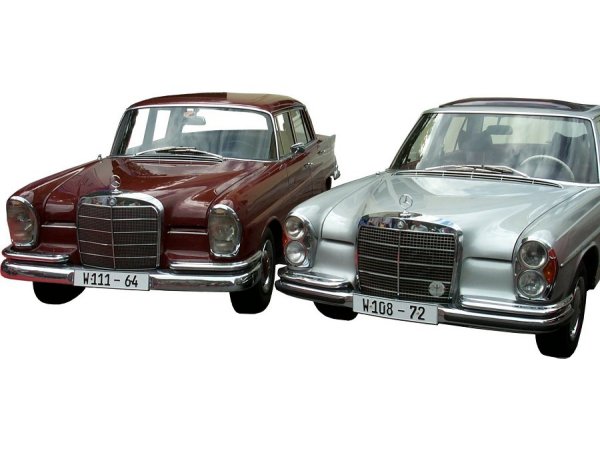


| Mercedes-Benz 220 SE (W 111) |
| Engine | In-line six-cylinder |
| Displacement | 2195 cm³ |
| Bore * stroke | 80 * 72,8 mm |
| Compression | 8,7 : 1 |
| Engine control | OHV (chain) |
| Valves | 2 per cylinder |
| Mixture preparation | Injection pump, suction tube |
| Fuel type | Premium gasoline |
| Torque | 189 Nm at 3900 rpm |
| Performance | 88 kW (120 HP) |
| Rated speed | 4800 rpm |
| Drivetrain | Front engine rear-wheel drive |
| Transmission | Four-speed, Steering column-mounted shifter, later floor-mounted shifter, four-speed automatic |
| Suspension (in front) | Double wishbone |
| Suspension (rear) | One-joint swing axle |
| Brakes | Drums
later disc brakes in front |
| Tyres | 185 H 14 |
| Tank capacity | 72 liter |
| Kerb weight | 1375 kg + driver |
| Maximum speed | Approx. 170 km/h |
| Construction period | 1959 - 1965 |
It is an attempt to make two model lines into one, a bit like today's platform strategies. Only at that time complete car parts also remain outside the same from 190D to 300 and differ only in the front car. But then one makes every effort to differentiate the two more expensive versions 220S and 220SE in appearance. Since the larger headlamps with fog lamps are combined under a lens. The bumpers are duplicated and the rear lights simultaneously larger and more pretentious framed accordingly.
This is the (economic miracle) period in which a customer wants to see/show something for all that money. The world should notice that he has done it. Thus, also the interior clearly distincts. Wood and chrome lift significantly the atmosphere. A later, barely reached thickness of the back rests with chrome-plated reclining seat devices and head restraints, whose fittings are drawn around the upper end of the backrest. Real wood instead of Bakelite also adorns the dashboard. However, the roll tachometer, held for modern at that time is with all tail fins the same.
That the larger front end would not essential have been necessary at least at the 220, the 230 demonstrates, whose six-cylinder engine was packed in the 14.5 cm shorter engine compartment of the four-cylinder. It is considered a hot tip of understatement, because all in all less conspicuous and faster than the 220S with carburetor and also than the 220SE with injection. For sporty breakthrough it lacks the floor-mounted shifter until 1964, although with the usual column-mounted shifter also are possible steering wheel circuit switching are remarkably remarkably low switching pauses.
The W108 is the continuation of the tail fin without tail fin. It is now recognized that this was just one fashion, swashing over from U.S. and returns back to normal mudguards at the rear, which Mercedes anyway described only as 'direction finding bars' for easier overview to the rear of the vehicle. This initiates, together with the introduction of prime/eight generation the separation of middle and upper class since 1968. 04/12
|
|

 "- click to enlarge !")