|
A B C D E F G H I J K L M N O P Q R S T U V W X Y Z
 Alfa Romeo 8C 2,9 Alfa Romeo 8C 2,9
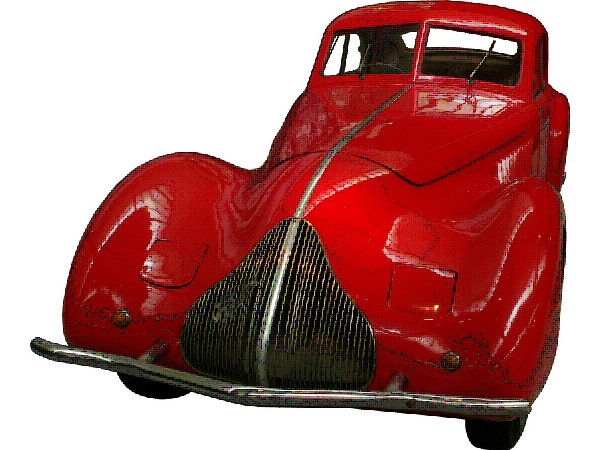


| Alfa 8C 2,9 Short-/long version |
| Engine | In-line eight-cylinder |
| Displacement | 2905 cm³ |
| Bore * stroke | 68 * 100 mm |
| Compression | 6,5 : 1 |
| Main bearings | 10 |
| Cylinder block | 2 x 4, Aluminum |
| Cylinder head/block | Welded |
| Fuel | Methanol-mixture |
| Engine control | DOHC (spur gears) |
| Mixture preparation | 2 carburetors |
| Supercharging | Roots charger |
| Lubrication | Dry sump |
| Performance | 162 kW (220 HP) |
| Rated speed | 5000 rpm |
| Drive train | Front engine, transaxle principle |
| Construction | Vittorio Jano |
| Transmission | Four-speed, unsynchronised |
| Suspension (front) | Lateral arm, coil springs, tubular damper |
| Suspension (rear) | Swing axle, transversal leaf spring, tubular damper |
| Wheelbase | 2800/3000 mm |
| Steering | Worm steering |
| Brakes f/r | Drums, hydraulic |
| Bodywork | Touring |
| Weight | Approx. 1000/1200 kg |
| Maximum speed | Approx. 200 km/h |
| Construction period | 1935 - 1938 |
The 8C 2,9 is considered the fastest car between the two World wars. Just the engine of his predecessor is kept; otherwise the design is completely anew. Quite a few features of this car are far from common at that time: for example its Transaxle principle, independent suspension and the hydraulically operated brake. In the version shown above, the car may have reached an enormous and unusual drag coefficient of clearly under 0.4. This car is successful for the brand Alfa Romeo. From 1936, it wins in three successive years the Mille Miglia and in 1936 the 24 hours of Spa. And what is even more astonishing, it wins the Mille Miglia once again after the war.
cartecc.com
Top of page
Index
2001-2015 Copyright programs, texts, animations, pictures: H. Huppertz - E-Mail |

|
|



 Italy 1
 "One of the fastest, in series-produced-car of this time - click to enlarge!")