
Bookstore
Exercises
Wheel change
Save Energy
History
Formulary

Ganz neu ...
Ganz neu ...
France 1
France 2
France 3
France 4
France 5
Peugeot
History
1891-1918
1918-1945
1945-today
2015 Vision GT
2015 208
2015 Bipper
2014 2008 Castagna
2014 108
2014 308 SW
2014 Boxer
2013 208 GTI
2013 308
2013 2008
2012 208
2012 508 RXH
2011 508
2011 3008 Hybrid 4
2009 RCZ
2007 207 CC
2006 207
2004 407
2004 107
1993 106
1992 905
1987 205 GTI
1986 205 Cabrio
1986 309
1983 205
1979 505
1975 104 Break Prototype
1975 604
1972 104
1969 304
1968 504
1965 204
1965 J7
1962 404 Coupe
1960 404
1955 403
1950 203 C
1948 203
1939 202
1935 402
1934 301 D Coupe
1934 401 Eclipse
1932 183 D Cabrio
1932 301 Torpedo
1931 201
1929 190 S
1929 201 301
1923 Type 172
1923 Type 174
1922 Type 153
1921 Type 156
1920 Quadrilette
1913 Type 146
1913 Bebe
1908 Lion VC
1906 Type 78 A
1905 Quadricycle
1903 Type 56
1891 Vis A Vis
|
 Peugeot 1918 - 1945 Peugeot 1918 - 1945
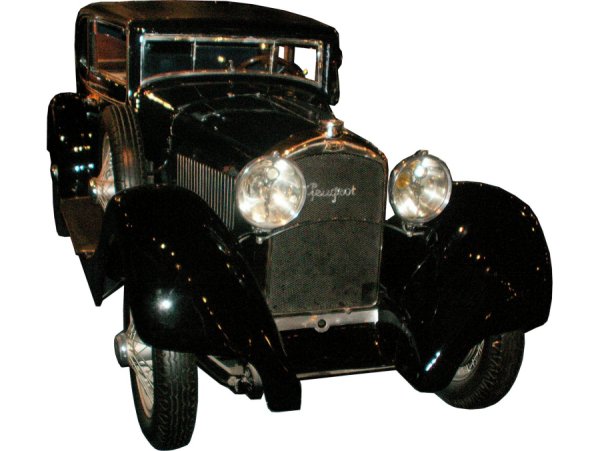


The fact that some products were in urgent need after World War I, helped Peugeot in regaining its strength. Thus the company started with the Quadrilette, an inexpensive car, much ahead of its competitors Renault and Citroen. Peugeot developed further towards one of the biggest companies in France. A range of products was offered, including also 6-cylinder engines.
Robert Peugeot led the company, apparently with a good overview. He arranged parts of the concern anew, and he introduced the name system, still valid today, with one zero in the middle (205). It was introduced with the Peugeot 201, marks the class (series) by the first digit and the temporal order of its appearance by the last. Thus a coming 301 should be a little bigger than a 201 and the 205 was to succeed the 204. Interesting also is the tradition not to stop the production of the predecessor immediately when the successor is introduced.
The first model named after this system was presented in 1929, and today (2006) we have the Peugeots 206 and 207. You see this system has a long continuance. Only nowadays there is a problem with two possible cars below the '2'. As there is not enough space they helped themselves with a double zero. At the time of the introduction of the system, Robert Peugeot was clever enough to patent this simple systematic. Thus, later on, Porsche was forbidden, to name a new car 901.
So Peugeot should be blamed that Porsche has a 911-series.The 201 was the base of the Peugeot vehicles from 1930 on. It had to compete against strong or cheaper competitors. Nevertheless, it asserted itself with its 1.1 liters of cubic capacity and 17 kW (23 HP). For the first time a bodywork was made in collaboration with Ambi-Budd in Berlin. The engine was later transmitted even to Audi. Adapting the 201, the 301 was introduced, indeed, with stronger engine and front independent suspension.
We approach the end of this time between both world wars which was marked by worldwide economic difficulties. Everywhere fusions were forced on automobile factories being badly in debt. Only Peugeot survived this time relatively easily. If there are a crisis in 1932, then the more homemade.
It was the time in which Peugeot conquered the North-African market, too and performed a lot of reliability testing. On this field the company acquired high merits, creating a lasting effect till today. And if today we associates the company almost exclusively with the rallye sport, then there is much racing development between the wars. The DOHC engines were already mentioned. 4-valve engines were introduced and valid cubic capacities with up to eight cylinders for different racing categories. Generally, the company seemed to specialise in engines. Still today it has fame as being one of the early (1928) manufacturers of diesel engines.
Mention should also be the model 401, which will be just a success as 402. For this is planned then even the first diesel version but there are in between the preparations for war.
Completely different from the First World War are the neighbour countries of Germany captured relatively quickly in the Second. This also the Peugeot factories brings in enemy hands. In rest they can look at all production and development locations of a former competitor. In addition, of course, the German armed forces should be supported. The factory management succeeds obviously a long time more likely to work for civilian fields. After that, the circumstances are unclear, because then mesh Allied bombings, sabotage and conscious induced bottlenecks in supply.
|
|

 "Light body, strong engine, being appropiated for racing - click to enlarge!")