
Bookstore
Exercises
Wheel change
Save Energy
History
Formulary
Ganz neu ...
Ganz neu ...
France 1
France 2
France 3
France 4
France 5
Peugeot
History
1891-1918
1918-1945
1945-today
2015 Vision GT
2015 208
2015 Bipper
2014 2008 Castagna
2014 108
2014 308 SW
2014 Boxer
2013 208 GTI
2013 308
2013 2008
2012 208
2012 508 RXH
2011 508
2011 3008 Hybrid 4
2009 RCZ
2007 207 CC
2006 207
2004 407
2004 107
1993 106
1992 905
1987 205 GTI
1986 205 Cabrio
1986 309
1983 205
1979 505
1975 104 Break Prototype
1975 604
1972 104
1969 304
1968 504
1965 204
1965 J7
1962 404 Coupe
1960 404
1955 403
1950 203 C
1948 203
1939 202
1935 402
1934 301 D Coupe
1934 401 Eclipse
1932 183 D Cabrio
1932 301 Torpedo
1931 201
1929 190 S
1929 201 301
1923 Type 172
1923 Type 174
1922 Type 153
1921 Type 156
1920 Quadrilette
1913 Type 146
1913 Bebe
1908 Lion VC
1906 Type 78 A
1905 Quadricycle
1903 Type 56
1891 Vis A Vis
|
 Peugeot 205 Peugeot 205
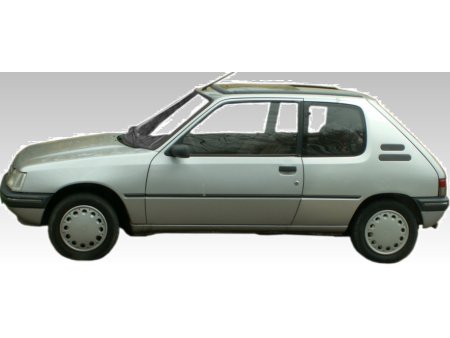


The company Peugeot was doing badly at that time. After years of growth there was a kink in the sales following the oil crisis in 1973/74. The French market was not that strongly affected by it, but the export to Central Europe and North Africa decreased. Economical cars, agile and nevertheless offering a lot of interior space would have a sales prospect.
In any case, the 104 was not the suitable product to rescue Peugeot, judging by its sales figures. After extensive market analyses and under the obligation to catch modernity the 205 was introduced, which actually should have been a 105.
The 205, especially with four doors, was a big success. The design of the car reached out, because Peugeot turned its back on edges, which had been for many years its feature, and created an extremely pleasing design. This was possible obviously only by an occasional break from Pininfarinas conceptions.
In France the car was available also with a 1-Liter-engine, but for exporting especially to Germany, there were the 1.4-Liter mentioned above, and the 1.8-Liter-Diesel engine. At the provisional end there were 147 KW (200 HP), a strong road version of the Racing vehicle with central engine.
|
|

 "Company saver - click to enlarge!")