Email
A B C D E F G H I J K L M N O P Q R S T U V W X Y Z
Formulary Generally Axle Load Distribution Payload Distribution Braking Distance Driving Force Work/Energy Radian Measure Tension (brake) Brake Force Brake Pedal Brake Force (wheel) De-/Acceleration Braking Distance Braking Period CO2 emission Density Torque Pressure Injection Quatity Electrical Power Riding Speed Centrifugal Force Gas Speed Speed Coaxial Gearbox Lever Ratio Hollow Cylinder Stroke-bore Ratio Displacement Power Output p.l. Hydraulic Ratio Capacity Piston Speed Piston Force Force Crank Mechan. Forces Fuel Consumption 1 Fuel Consumption 2 Fuel Consumption 3 Ciruit Area Circuit Ring Circumference Clutch Pedal Power (mechanical) Power (effective) Power (indicated) Efficiency Weight Wire Resistance Steering Ratio Volumetric Efficiency Air Ratio Venturi Air Resistance Parallel Circuit Planetary Gearbox Percent Rectangle Rectangle Column Friction Force Tyre Calculation Serial Circuit Rolling Resistance Cam Dwell Dwell Period Slip Spread of Gears Climbing Resistance Ratio Circumference speed Conversions Not Coaxial Gearbox Valve Opening Area Valve Opening Angle Valve Opening Period Compression Ratio 1 Compression Ratio 2 Amount of Heat Resistance Efficiency Cube Ignition Interval Cylinder Mathematics 1 Mathematics 2 Mathematics 3 Mathematics 4 Mathematics 5 Mathematics 6 Mathematics 7 Mathematics 8 Mathematics 9
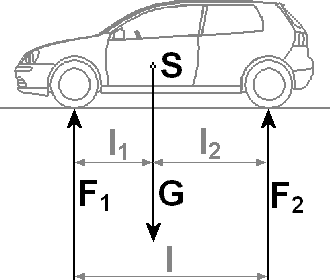
The position of the center of gravity determines the individual axle load. Only when the vehicle is in a state of rest, is it stable. When starting off forwards the center of gravity shifts to the rear, when braking it shifts forwards and when cornering it moves somewhat to the outside of the curve. It must be recalculated for each situation.