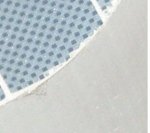
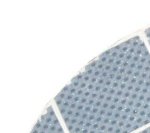
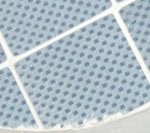
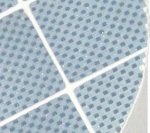
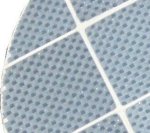
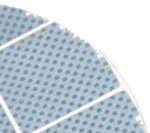
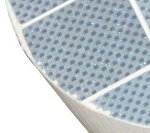
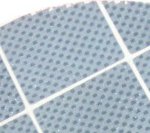
Finally, it can be seen here in full size. It's possible, that the same carrier material, a ceramic base, is used as in the catalytic converter. In contrast to this however, the porosity between the channels is decisive. While in the catalytic converter all the channels are open on both sides, in the particle filter, each channel must be closed on one side or the other. The channels also do not have a constant cross-section, they are conical towards the ends to enable them to gather more material to be filtered. In the meantime, sintered metals are also being used as a carrier material. The exhaust gas must definitely pass through the (porous) material. Once the first solid material begins to block the openings, the particle filter reaches its greatest effectivity. This means however, that, to be on the safe side, the porosity must always be greater than necessary. The particle filter may, under no circumstances, be completely clogged. This would allow the particles an almost uninhibited flow through the exhaust. The classification, eg., Euro-4-norm concerns all the exhaust gases (eg. also nitrogen-oxides). Thereby, it is of no significance whether a particle filter is present or not. If a vehicle collectively complies with the Euro-4-norm classification, it can comply, in the case of individual pollutant components, also with the Euro-5-norm. Vice versa, vehicles classified as Euro-4 without particle filters, can, eg., when accelerating, emit large amounts of soot. Nonetheless, one can assume, contrary to some reports, that these exhaust fumes contain no additional pollutants (like eg., Dioxin). 11/12