An ignitable mixture should be formed in the proximity of the spark plug and a very lean one in the remainder of the combustion chamber. Fuel saving is the aim in this operational range (partial load) with an average Lambda of approx. 2.7 to 3.4.
How it works
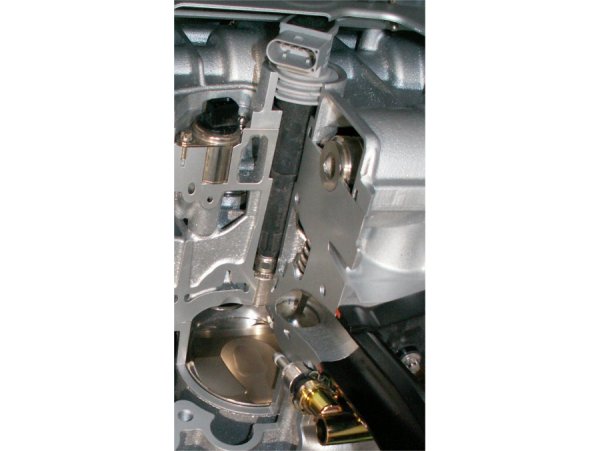
The air baffles in the picture above - which are the same for all cylinders - are now somewhat closed. The air enters the combustion chamber with a strong swirl. In addition there is a stratified injection in the last third of the compression stroke. If the piston has - as in this case (see picture) - one or two cavities, this indicates wall guidance.If the fuel stream is just added to the whirling air flow, it is air guided. In both cases an ignitable mixture forms in the proximity of the spark plug, and a lean one in the remainder of the combustion chamber. Besides the difficult control (hesitations in acceleration are possible) and the switching between the modes of operation (passengers should not feel it), the exhaust gases are one of the main problems, because in this mode of operation they contain too many nitrogen oxides (NOX). A solution is to install a catalyst for nitrogen oxides in the exhaust strand, the DeNOX-Kat (lat. de = decrease). Before they are released into the environment, the nitrogen oxides are deposited here. It is also called a NOX storage catalyst and it contains besides platinum-, rhodium- and palladium layers a fourth coating, barium oxide.If there is a lack of space (indicated by a sensor) the catalyst can be regenerated by a brief enrichment of the mixture (Lambda smaller 1). This works best with ultra low sulfur fuel, because the sulfur occupies the positions of the nitrogen oxides in the catalyst as they inhibit a similar chemical characteristic. This leads to more frequent regeneration phases, which reduce the fuel economy. Low sulfur fuel is offered occassionally, but not generally yet.
Future
The design differs substantially amongst the various manufacturers. The design as outlined above with the air buffle and wall guidance of the piston represents only one possibility. The principle of the stratified injection under high pressure is however the same for all manufacturers. Some do not make use of the stratified-charge operation. The promised fuel saving with partial load and stratified-charge operation are not yet comprehensible in reality.





 "High pressure pump for the fuel stratified injection - click to enlarge!")