|
Four-stroke Engine
| There have been already engines without compression. |
The predecessor of the four-stroke engine is the atmospheric gas engine, which - as the name says - ignited an uncompressed fuel-air mixture. During the
development of the four-stroke engine in 1876, the added compression of the mixture through the 'compression-stroke' was introduced. A more effective combustion was
created. By compressing the air, the combustion distance is reduced (carbon atoms search for oxygen atoms). In the first stationary test-engine, there was little of this to be
found. It ran on lighting gas, had a cubic capacity of 6,1 liters and developed 3 hp at 180 RPM.
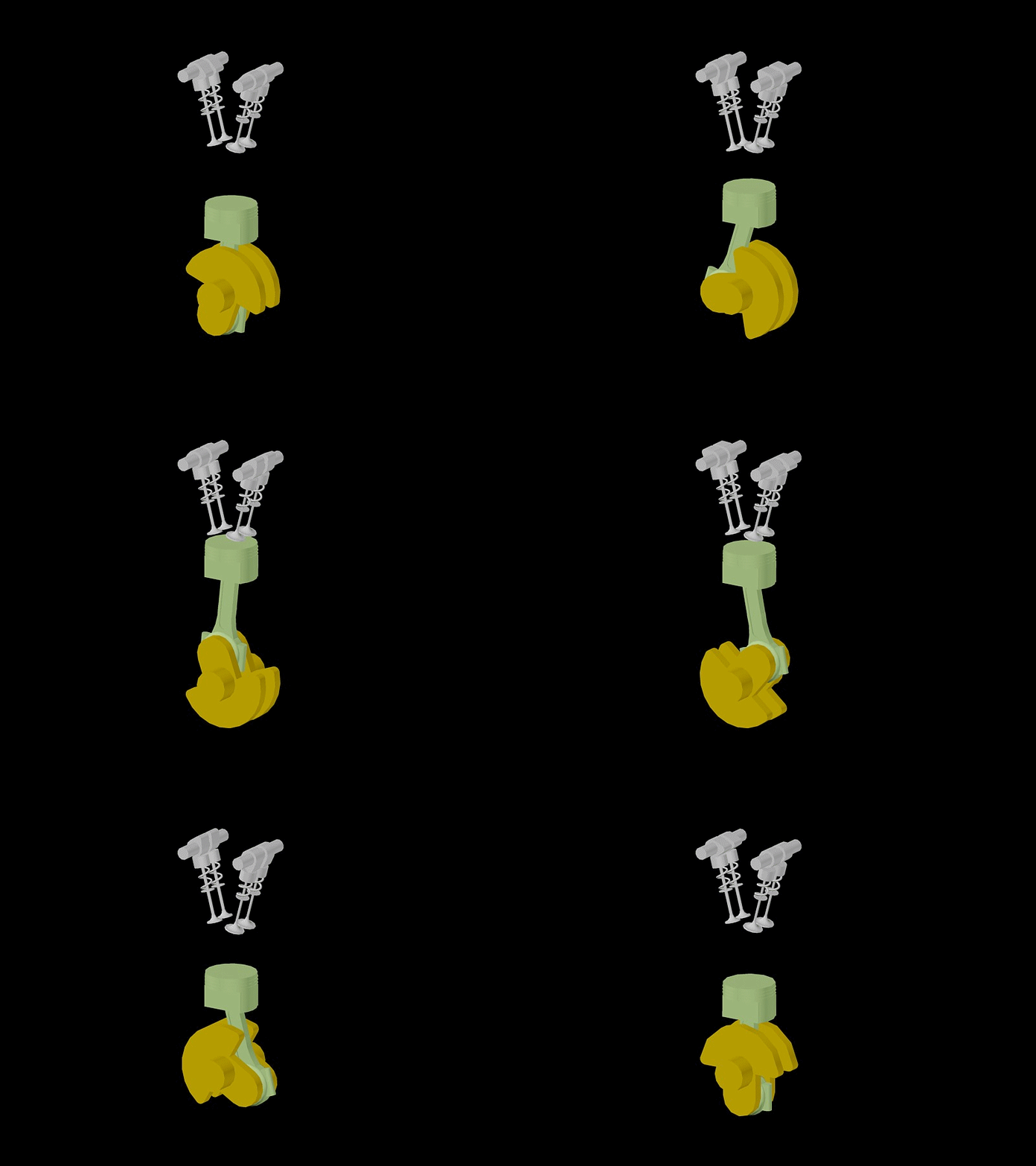
| Operating cycle: Intake, compression, ignition, exhaust |
In contrast to the two-stroke engine, The processes of intake, compression, combustion and exhaust-stroke all take
place one after the other. The compression area always remains constant. In this area, through the piston-stroke and during a half a crankshaft rotation each, the gas is compressed and expanded. The in- and
outflow of the gases is regulated by the engine control.
| Irregular rotary movement during the 4-strokes |
The rotation speed of the crankshaft, throughout the four-strokes, is by no means constant, particularly when comparing the compression- and combustion stroke. In the
first case, the piston is slightly retarded, in the second, it is substantially accelerated. This is noticed by the starter-motor, which turns a good deal slower during the
compressing in the individual cylinders, which means it takes on more current.
| Irregular rotary movement during the 4-strokes |
Through the control of the gas exchanging, the cylinder is kept relatively free of exhaust gases. Should exhaust gases be introduced
into the fresh gas, this can be done specifically through the exhaust gas recirculation. Modern engine controlling with adjustable camshafts and variable valve-lift can even achieve an optimum cylinder
filling in all RPM ranges. This obviously also means, an improvement in both the fuel consumption and the exhaust gas values. It would appear however, that all this can also be had in
a much more compact construction, the two-stroke turbo-Diesel engine. 04/12
|
|