|
Turbo Charger
| Turbocharging for diesel and more and more also for petrol engines |
The turbocharger has become an integral component for modern internal combustion engines. Almost all directly injecting diesel engines of the passenger car up to the ship diesel are charged. Due to its early starting
and limitation in the boost pressure an old dream of driving becomes true. To be able to powerfully accelerate from relatively low revs. In the meantime, the turbocharger starts to conquer a larger market share than
presently 10% of the petrol engines. The turbocharger could either compete against the compressor and probably win, or
establish a combination. Also the
variable compression seems obsolete, because, in the meantime, the boost pressure is regulated electronically.
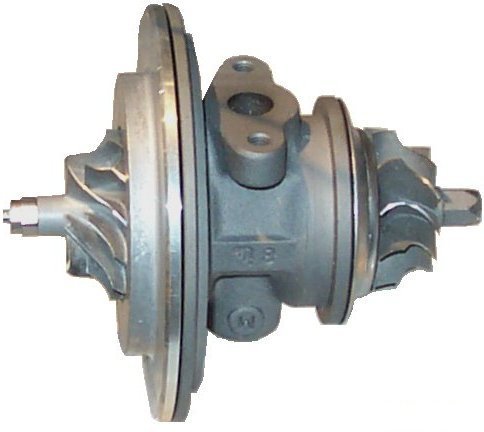
| Turbine (intake) and compressor(exhaust) on one shaft |
The turbo-charger consists of the turbine (on the right) and the compressor (on the left) both being on one common shaft. The shaft bearing must be able to cope with more than 260.000 RPM. Of course, it is connected
to the engine oil circuit, this caused problems in the beginning due to the prevailing temperatures there. Sometimes there is also a coolant connection. The turbine is driven by the exhaust gas of the engine. The
compressor provides for a pre-compression of the fresh air. It should ideally, already generate a high boost pressure, even at low revs. This can be regulated through a variable turbine geometry or a bypass valve (waste gate). From a certain amount of boost pressure onwards it opens the direct path to the exhaust
system, avoiding the turbine wheel. This valve can either be regulated pneumatically by the pressure in the inlet manifold or electrically.
The strain is so high, that one can partly speak of a second engine. Thus, the turbine in e.g., a second generation Porsche-turbo (1977), at max. charging pressure, takes about 30 kW (41 hp) from the sytem. This
amounts to 13% of the engine performance, even though these turbo-chargers only turn at up to 90.000 RPM and the outlet temperature of the charged air amounts to 130°C.
| Adjustable and twin chargers improve the responsiveness |
Because of the lower exhaust gas temperature (more with Diesel engines) the compressor blades are adjustable, in this case, one can sometimes do without this valve. To avoid, e.g.,
when closing the throttle valve, and/or too strong a deceleration of the compressor wheel, a bypass valve (blow-/pop-off valve) may also be installed on the compressor side.
The number of engines with more than one charger is increasing. These are mostly installed parallel, can however, also be serially switched. Diesel engines (particularly in utility vehicles) run with higher pressures of
maximum 1,5 to 2,5 bar, standard car petrol engines run rather with pressures of less than 1 bar. When serially switched, pressures of approx. 5 bar have been reached, indeed, only in racing cars using qualification
engines. High temperatures when compressing are reduced by using an air-to-air heat exchanger (intercooler). In the second
picture one can clearly see, how the exhaust pressure is directed onto the blades of the turbine wheel. Oppositely, the fresh gases are accelerated from the center and then pressed, through a narrow gap outwards.
| No more driving with too little compression |
The maximum pressure is determined in the Diesel engine mainly through the engine-strain, in the Otto engine however, it is determined by the anti-knocking properties of the fuel. Because there were (up to 2006) no
standard engines, whose compression ratio could be mechanically adjusted to suit the operating conditions, the Otto engine with a rigidly set wastegate (by-pass valve), runs in the range of too little charging pressure,
thus, with a lower effeciency. This can be only inadequately compensated for by the ignition timing, an electronic charging-pressure controlling is far more efficient. This allows substantially higher compression ratios
than before. In this respect at least, a modern petrol turbo-charged engine with this characteristic value, can hardly be distinguished from a naturally aspirated engine, which becomes positively apparent as far as fuel
consumption is concerned. Together with the stratified charge operation of a direct petrol injection and variable valve
lifting, even more can be achieved.
| The responsiveness is worse than that of a naturally aspirated engine |
Unlike it's counterpart, the compressor, the turbo-charged engine has been accompanied, from the outset, by one disadvantage,
the response-lag (turbo-lag). Although a Diesel engine with a turbo-charger has a lot of power at very low revs, one has to take care when pulling off, otherwise the engine may stall. This is actually, not at all typical of the
Diesel engine. With the earlier, non-charged models, this was almost impossible, which in addition, made them suitable as driving school vehicles. It takes a moment, until charger-revs have reached the respective
accelerator pedal position. A little of the old turbo-lag still remains. Relief could possibly be found in the shape of an additional electrically driven charger, which would, as a precautionary measure, increase the revs of
the blade-wheels when idling with an opened charger-pressure-valve.
| Exhaust temperature: Max: 970°C - 1050°C (short term) |
There are also aesthetic reasons which speak against the turbo-charger, eg., as at the moment, held by the Mercedes-tuners, AMG. They partly favourise the naturally aspirated engine because of it's wonderful sound,
which apparently, is lastingly damaged by the turbine in the exhaust gas flow … 06/12
|
|