Wheel Alignment
Assignment
A slight deviation from the zero-alignment position should enable the wheels of one axle to run smoothly without wobbling, to stabilise the straight running and keep the vehicle on track.
Function
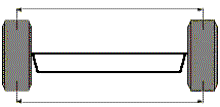
The alignment of an individual wheel marks the angle in which the wheel stands in relation to the longitudinal axis. If the wheel is parallel to this axis, then the alignment position is zero. If the alignment values of both
wheels of one axle are added together, one arrives at the whole alignment value. It is positive (toe-in) when the front wheels move toward each other and negative (toe-out) if their distance is at the front greater than the rear.
Previously, the front axle of front-wheel drive vehicles was adjusted to toe-out. But that would continue to apply but only for front axles with positive steering roll radius. If the is negative, there is only very little deviation of trace
zero. Rear driven cars are set more likely to toe. Often a slight toe-in prevents light wheel movements about the pivot axis. For rear rigid axles, the track is always zero.
A little toe-in thus makes for that wheel a certain skew angle. This also applies to the rear axle in modern undercarriages. This skew angle may even additionally change itself with spring compression. Of course, it
increases the rolling resistance and tyre wear. If the toe-in at the two wheels of an axle is not equal, even lateral forces may arise.
Unfortunately, the very simple method of aligning the wheels, (using a bar) by comparing the distance between the the front- and back edges of the wheel-rim, is not yet completely extinct. Perhaps it is still justified in the
utility vehicle area, or as an emergency measure. The different measurement values from the conversion of the alignment shown in degrees, to the necessary millimeters, is interesting. This can be done using the formula
for the radian measure by giving the wheel-rim diameter and the angle. Because of the front/rear comparative measurement, the radian measure must
then be doubled.
With 13- or 14-inch wheel-rims, approx. 10 minutes of angle represent one millimeter of difference. 02/09
|