Balcony Power Plant 6 Balcony Power Plant 6
Have we thought this all the way through? Of course not, because so far these have all just been thoughts about what the system is capable of and how it fits into our small system now and in
five years. But, we haven't put anything into practice yet. The equipment hasn't even been delivered yet.
That’s another downside, because even with this system, we find ourselves eagerly watching the weather outside and wondering how much electricity we could be saving right now. And with one system that has not yet
been delivered and another that is currently out of service.
There were also problems with the delivery of the inverter. Our smartphone is too old and hasn't been updated to a newer version of Android yet. So we haven't been able to pick up the
package from the 'Packstation' on our street yet.
Apparently we weren't home, so that's how it ended up there. If the Packstation weren't so brand-new, it would have a display where you could enter the notification code. Everything has been
streamlined. Now, because of the backorder, we're not mobile for another day.
At least we had enough time to plan the installation of the panels and the cable routing. The former are placed individually next to the existing ones, which move slightly to the side to make
room. But that's only three rows. The fourth is attached crosswise to the wall at the end of the pent roof.
For the eight wires leading there, we would cut open the original ones and significantly extend them using NM cables in one or more junction boxes. Two 5 x 1.5 mm2 would be
possible, or, more elegantly, four 3 x 1.5 mm2, in which case each panel would have its own supply.
The route to get there depends on the location of the batteries and the electronics. We prefer a location very close to our main living area, because we want to try out a few things at first.
Actually, the path is no problem because of the empty spaces created by the many renovations in our house.
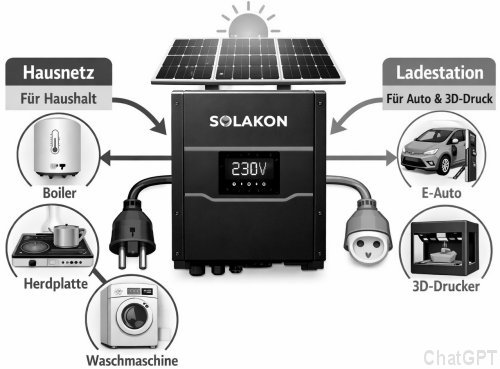
Imagine the Land of Milk and Honey. Solakon for hot water heating with just 800 W and a timer. It heats when neither the washing machine is running nor the main stove is in use. Everything
works automatically; you just need to keep certain usage times in mind.
The 3D printer will be next to Solakon, and the electric car isn't far away. If the battery is about to overflow, the devices are connected to its outlet in this order, the only times we would need to
intervene.
ChatGPT calculated for us that directly heating the 300 liters in our boiler from 45°C to 55°C using 800 W costs about 3.5 kWh, plus losses. The heating process should take about four hours.
The gas heating will remain turned off throughout the summer. However, the 800-watt heating element must be installed in such a way that it does not interfere with the gas heater’s ability to
heat the water in winter. At least we hope to have enough power left for experiments with the 3D printer.
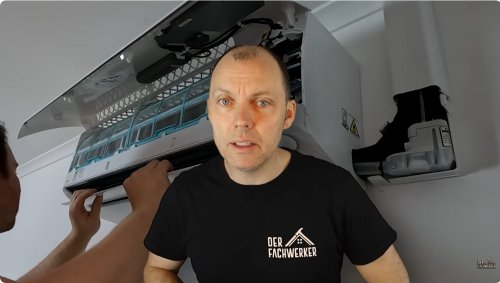
The next step, if we manage to do it, would be to install a split-system air conditioner in our living room, which is the largest room. After checking how much noise a unit like that makes, we’ll
probably go with a (slightly more expensive) floor-standing model.
kfz-tech.de/Ye284
|