Balcony Power Plant 2 Balcony Power Plant 2
You won't believe it, but even though four chapters were already finished, we're now rewriting them from scratch because, despite the tight deadline, important information has kept coming in.
As I said, we still haven't received any advertising revenue from Solakon.
What is our current inventory, which we are using as a basis? There are 12 solar panels, which I installed myself in 2010; together they have a peak output of 2.5 kWh, and at the time the
materials cost a total of more than 10,000 €. That sounds like a lot, but they still paid for themselves after 10 years.
In addition, an electric car with a 64 kWh net battery capacity. There’s something else of similar importance to be added, but more on that later. As you may know from this website, we love
model railroads and
we struggle to get the 3D printer running.
If you watch the video below, you'll learn a lot more about the system we purchased. This is necessary because the system's capabilities far exceed those of a standard
balcony power plant. But let’s start with them first.
Of particular importance is the 800-watt limit mandated by law, which specifies the maximum amount of power that may be fed from the collectors directly or from the storage tank into the
home’s electrical system. You can also connect more than one balcony power plant, but the total power remains at 800 W.
Now you might think we’re crazy for the first time, how do we plan to get rid of 12,660 W of power when the storage is full, given that the maximum capacity of each battery is 800 W? That only
works
if the devices draw at least 800 W or more.
| Abroad, the power rating apparently goes up to 1,200 W; the devices
are capable of this, but are blocked in Germany accordingly. |
A washing machine actually uses more electricity, though only for a relatively short time while heating the water. The legislature has really thrown a wrench in our plans. But such a balcony
power plant has its advantages, too.
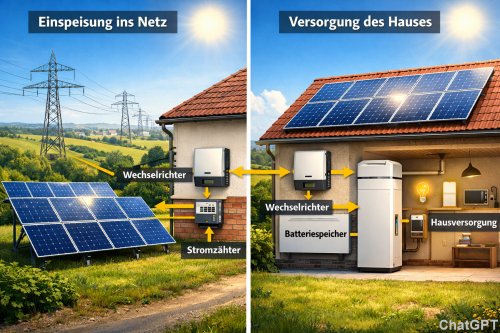
Anyone can set it up, because if you choose the storage option, all you have to do is stack the units, which come with pre-wired connections, on top of each other, connect the cables to the
solar panels, and plug the whole thing into a standard GFCI outlet.
The best part, however, is how little you have to worry about the system once it's been installed. Whenever power is drawn from the grid, the lowest 800 W are automatically replaced. So, no
power is drawn from the grid below 800 W.
That sounds like something out of a fairy tale, but the harsh reality follows immediately. Unfortunately, all of this happens on only one phase, specifically, the outlet selected during installation.
The other two phases continue to draw all their power from the grid.
So if you hadn't plugged into the outlet on that circuit where your washing machine is connected, your savings would have been for nothing. Conversely, however, if this were powered by a
separate source, the entire balcony power plant would only be worthwhile during the washing machine's heating cycle.
As you can see, it’s not just about the power consumption being as high as possible, over 800 W, but also about the length of time during which the device, or other devices on the same
circuit, operates at that power level.
|