|
| 
|
 Quality/Quantity 1 Quality/Quantity 1
And what about a diesel engine? In principle, you could also determine the lambda value for that. And that’s exactly what we do, since diesel engines now come equipped with lambda sensors as well. But at the moment of
injection, there is initially nothing but air around the fuel jet. By the way, the much higher injection pressure naturally results in a loss of efficiency at first.
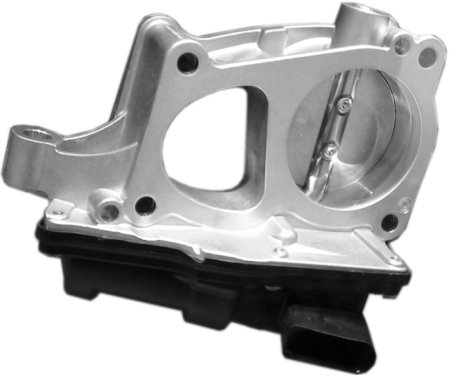
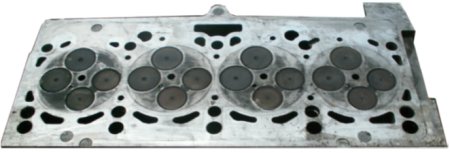
Let’s take a closer look at how the diesel engine not only makes up for this loss under partial load but also outperforms the gasoline engine in every respect under these operating conditions. Whether it's swirl flaps
(top image), a specially designed intake duct (bottom image), or other measures, turbulence in the airflow is definitely welcome.
Fuel is now injected into this heat - generated by the high pressure of compression - under even higher pressure, causing it to burn immediately, at least at the edges. Actually, the diesel engine doesn't care how much air
is in the combustion chamber. Its spray jet reacts only to the oxygen that may be carried to it by air movements.
Imagine a rocket that generates, say, 19 million kW (26 million hp) even in a vacuum, but has to carry oxygen along with its fuel. And only by correctly join together the two can combustion produce such a powerful recoil.
That is not the case with a diesel engine, however. In this case, the increase in pressure acts on the piston.
But we're talking about quality control here. It is said that a diesel engine injects varying amounts of fuel into a constant volume of air, depending on the required torque. Of course, the air volume isn't always exactly the
same; for example, it decreases at high engine speeds. But the fact remains: there's always too much air. The lambda value is therefore at least about 1.4, but can rise to 4 or higher.
The gasoline engine is a completely different story. If the fuel-air mixture is too lean, even the best and most precise ignition system won’t do any good at all. With a lambda of 1.4, most gasoline engines won't do anything
anymore, unless they have stratified charging. In fact, it delivers the most power with a slightly rich mixture (lambda = 0.95). It is more fuel-efficient only with a slightly leaner mixture (lambda = 1.05).
But you have to offer the spark plug a mixture within this lambda range; otherwise, you'll run into one malfunction after another. It is said that, unfortunately, older diesel engines will still run even when the air-fuel mixture is
misadjusted, unlike gasoline engines. It would be better if they stopped operating so the problem could be fixed.
The gasoline engine therefore operates on the principle of flow control. The key factor here is the amount of the air-fuel mixture, the composition of which should remain as consistent as possible. However, in a
conventional gasoline engine, this rule is deviated from under various operating conditions, particularly during a cold start. This happens because fuel deposits on the intake or cylinder walls, possibly no longer being
available for combustion, so the mixture must be enriched accordingly.
And the gasoline engine can only accelerate, that is, shift to a higher engine speed, by injecting more fuel. At first, there isn't enough air available, which means a richer mixture. Once the higher RPM is reached, the engine
management system, for example, reduces the fuel supply. There is also a potential for savings here thanks to the hybrid powertrain. Because if an electric motor brings the internal combustion engine up to a higher RPM,
you can skip the pre-lubrication.
|
|