Without a test drive Without a test drive
Much tinkering back then, even though or perhaps precisely due to studying the subject with the aim of becoming a teacher. Strangely enough, something often happened then. However, what happened to me had less to
do with tinkering than anything else.
But did this silly mistake happen only to me, or maybe to others as well? But this question doesn't really serve as an apology. A close friend was looking for a VW Bus to take a road trip to Turkey with his girlfriend.
So far, so good, but as was often the case back then, money was tight. He knew next to nothing about cars, that’s why he had me. And even though he didn't have much money, I definitely recommended a T2 to him. I
thought and still think that the car is just great, even today.
No, this isn't the time for gushing praise, but let me just say this: If you have a choice and aren't an archaeologist, just go with the T1 because the two are worlds apart. But what can you do with such a small
budget? Please not too much welding work.
And then a perfectly decent car turned up with a serious engine problem. When we disassembled it and shook it, you could hear all sorts of loose parts rattling around inside. Sure, we bought it
because there was still a Beetle engine available as a possible replacement.
The fact that it had a displacement of only 1,300 cc, and that this engine size wasn't even available in the T2, didn't matter; you can make it all the way to Turkey even with just 1,300 cc. For someone who studied geography,
the journey was the destination. But anyone studying automotive engineering shouldn't assume that everything at VW is interchangeable.
That was exactly the crux of the matter. If we had chosen a T1, the engine would have been mounted solely and exclusively on the transmission housing. The T2, on the other hand, had this ugly crossbar at the rear, just
before the exhaust. And where was it attached? To three additional threads on the engine block.
Yes, we still had another engine, but it dawned on us that we, or rather, I, would have to completely strip it down, including the crankshaft and oil pump, and had to hope that at least the housing of the other engine
is still usable.
So, three afternoons in a barn on the girlfriend’s landlord’s farm: I took apart the exhaust system, including the heating bulbs, the blower with the generator and ignition wires, the carburetor with the 'deer antler', and the
distributor along with the fuel pump. If I've forgotten anything, I'm sorry, it's been a long time.
Then there were the rocker arm shafts; it’s best to maintain the order of the pushrods. Once the nuts on the cylinder heads had been loosened, things got interesting. Because those are the only ones you should just
remove, but you shouldn't just pull on the cylinders.
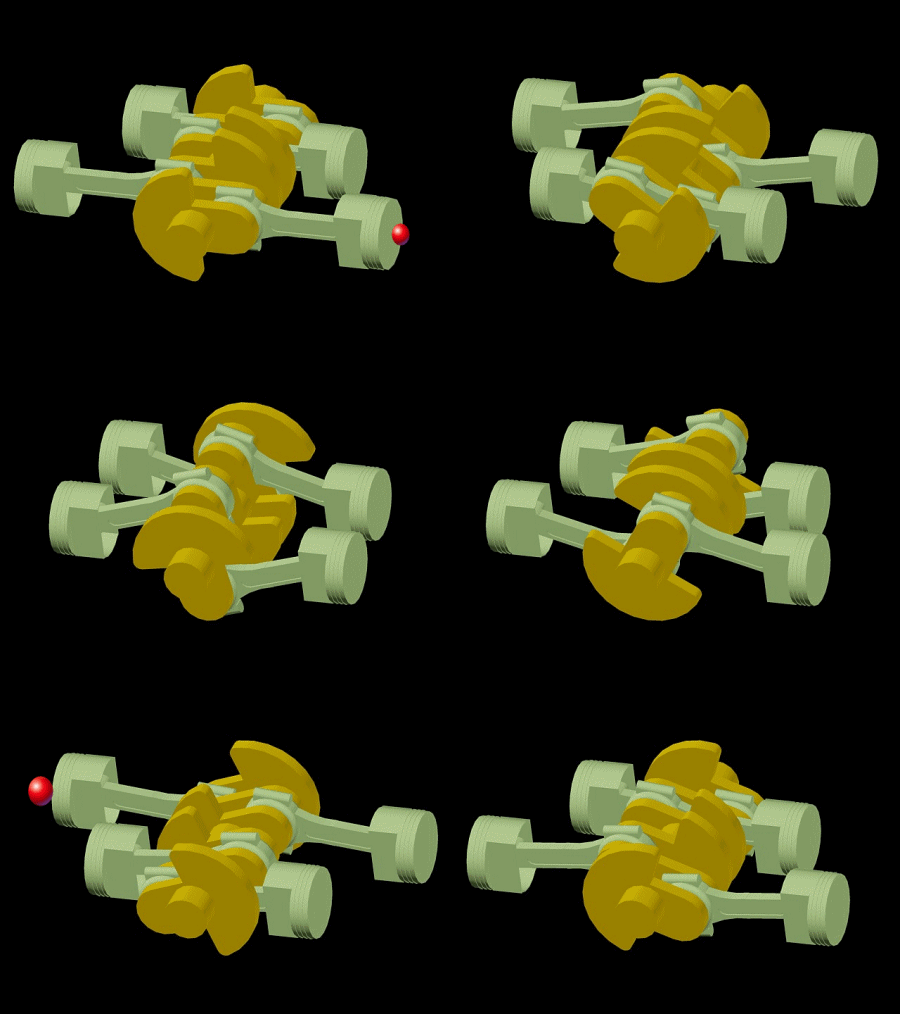
In our case, it was enough to expose the piston pins without tapping them all the way out. After that, the engine block was laid bare, with the connecting rods sticking out. Its two halves then revealed the crankshaft and
camshaft.
And lo and behold, one or more cylinders in the other engine had been completely demolished, but the engine block had remained intact. So I put everything back together the other way around, using the gasket set and
sealant. To be honest, I was surprised at myself.
Actually, almost more about my boyfriend and girlfriend, because when I showed up the next day for the test drive, the two of them, along with the VW Bulli, were gone. My wife still remembers how cheerful the
two of them were when they came back. Everything seemed to have gone smoothly, even without a test drive.
|