Crankshaft
kfz-tech.de/YVe29
Where does it come from? In any case, it didn’t originate in connection with the internal combustion engine. Even the steam engine had something resembling a crankshaft; In the case of the steam locomotive, it was even
visible from the outside. But it is probably even older than that.
Not all internal combustion engines have crankshafts – just think of the Wankel engine. There was also one that consisted almost entirely of pistons and rods and transmitted its energy in the
form of pressure.
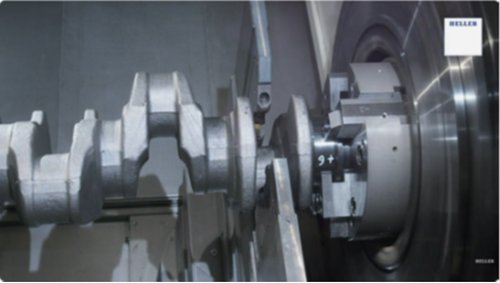
The crankshaft provides nothing less than the eccentric bearing of the large connecting rod eye. It may be cast or forged, but even if it is formed from a large cylinder, it must always be machined on a lathe with specific
requirements.
It is very often supported by plain bearings, but roller bearings are also possible, even different procedure at main and connecting rod bearings, which would clearly differentiate the two types of bearings on a crankshaft.
The connecting rod bearings rotate, whilst the main bearings remain stationary.
This naturally makes lubrication more difficult in the former case; in the very early stages of development, lubrication was sometimes provided entirely or partially simply by spraying engine oil onto the parts. But for quite
some time now, it has been supplied through pipes to the main bearings and from there to the connecting rod bearings.
In the case of roller bearings, this type of lubrication is called hydrodynamic, which means that it only works really well at a certain rotational speed and with sufficient pressure. However, the former has been significantly
reduced over the course of the development of fuel-efficient internal combustion engines.
Only two main bearings have been there in the history of engines, even in those with up to four cylinders, but this is actually only common in single- and two-cylinder engines. Even the latter models are available with an
additional center bearing. Nevertheless, for larger ones, their number does not necessarily have to be equal to the number of connecting rod bearings plus one.
Four-cylinder inline engines are very often mounted on three bearings, while six-cylinder ones are mounted on four. Four-cylinder boxer engines also have three bearings, while the few six-cylinder models may have four or
even seven bearings, as is the case with Porsche, for example.
The crankshaft does not always have to provide a separate connecting rod bearing for each cylinder; two connecting rods can also share a single connecting rod bearing. One example is the classic V6
with a 60° angle between the cylinder banks.
A third component on the crankshaft would be the balance weights, which are actually omitted only in certain boxer engines. They provide some, though not necessarily complete, balancing of the crankshaft, adjustable via
blind holes drilled into the weights.
There are also considerations to accept the unbalance which the rest of the crankshaft assembly implicates. Crankshafts are extremely important for keeping the engine's center of gravity low. It's not boxer engines
that are the best - since they have to accommodate their exhaust system - but V-engines.
As you can see, the crankshaft is essentially the central component of the internal combustion engine. After all, it also determines the engine's displacement based on the stroke and influences the
compression ratio.
kfz-tech.de/YVe15
|