|
| 
|
 Internal piston engines Internal piston engines
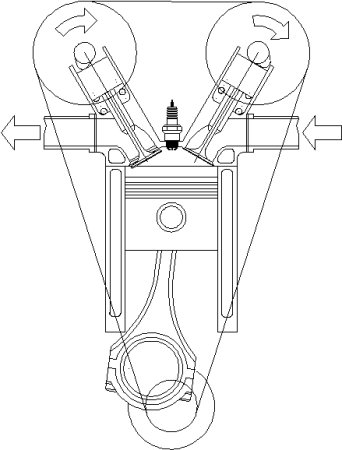
The internal piston engine comes in countless varieties. The piston does not necessarily have to move in a linear fashion (reciprocating engine); it can also rotate, as we saw with the Wankel
engine. In this case, either the crankshaft or the camshaft may rotate, or the entire engine may rotate around them, as reported in the case of the rotary engine, a variant of the radial engine.
There are also pistons engines with more than one crankshaft. Thus, one can be arranged on each side of a single cylinder, or, more commonly, multiple cylinders, allowing two pistons
within that cylinder to move toward each other and then away from each other. As with a conventional two-stroke engine, all valves are dispensed with, and scavenging is achieved through
slots that open as the piston approaches bottom dead center.
There they are: the terms related to the dead center. Since the cylinder head of a reciprocating engine does not always point upward, we define top dead center, for example, as the point
farthest from the crankshaft, and bottom dead center as the point closest to it. So these two points would be at the same height in a boxer engine.
These are important specifications, which are sometimes even verified metrologically, because many critical measurements, such as the ignition timing, are referenced to them. How can you
verify that? In the best-case scenario a gauge screw can feel the piston through the spark plug hole and tell us exactly when it reaches TDC. Now all you have to do is mark the flywheel
accordingly.
By the way, pistons don't always have the shape we're familiar with. Of course, that isn't the case with Wankel or rotary engines anyway. However, Honda, for example, has also attempted to
shape the piston with an oval cross-section, like two beer cans standing side by side with smooth sides, in order to increase the available space for valve openings. However, the idea didn't
catch on.
It is clear that, in all piston engines, one thing is essentially always the same: a combustion chamber filled with a gaseous mixture (and possibly fuel droplets) is compressed, and then returns
to its original size when the mixture is ignited. However, this refers to internal combustion piston engines, which means that steam engines, for example, which operate on the principle of
external combustion, are excluded.
|
|