Piston Manufacturing Piston Manufacturing
kfz-tech.de/PVe59
To make a clear distinction right from the start: In this chapter, we are discussing exclusively aluminum pistons, even though steel pistons, albeit in smaller numbers, seem to be gaining
ground. The casting process requires melting the material to a temperature well above 600°C.
You've probably heard this before. The aluminum bath rests quietly, and even though the aluminum purchased on the world market comes in blocks with a purity of well over 99 percent, so-
called impurities that accumulate on the surface must be skimmed off repeatedly. It is essentially the oxidized surface of the raw material.
What is perhaps less well known is that aluminium and water get along much worse than dogs and cats sometimes do. Anything that comes into contact with aluminum must be free of moisture,
because otherwise a violent reaction will occur. After all, a molten quantity of aluminum, say, half a ton, is enough to destroy at least half the factory building.
It's surprising that a melt that's already at the right pouring temperature still has to go into an induction furnace. It's because of the alloys that are added here. This furnace
stirs the melt just enough to ensure that the filler materials mix thoroughly with the aluminum.
What are the alloying elements? It is common knowledge which ones are eligible, but the specific percentages are a trade secret. First, silicon is added, which strengthens the aluminum and
makes it more resistant to wear. It is much harder to say exactly how magnesium, vanadium, zirconium, copper, and nickel affect the alloy. Some components are chosen solely to influence the
development of others that are particularly important.
It is interesting to note that the exact composition can be verified using spectral analysis, not least because “waste” is generated not only during the casting process but also during
subsequent manufacturing, and this is reused. Of course, its effect on the alloy composition must then be factored out. The atoms and molecules of a small sample are measured after it has
been heated until it reaches the gas phase.
Whether they're pistons for cars or trucks, they're all cast in the same way. It is important that the molten material maintains a temperature of over 700°C during transport and has the required
purity, i.e., is free of gases that could cause bubbles later on. There are metal components in the aluminum piston, such as the ring strips of the past and, today, ring carriers, that are molded
during manufacturing. In addition, salt cores are used, for example, for surrounding channels, which are later dissolved with water.
Of course, the pistons need to cool down before further processing can take place. So a lot of time is lost in the intervals between the individual processing steps. For the up to 16 steps that
may follow, the actual processing time is relatively short, but of course the piston must also be transported.
When working with a cast workpiece, you must always first create one or two surfaces on which it can be clamped. This allows tolerances of up to one-hundredth of a millimeter to be
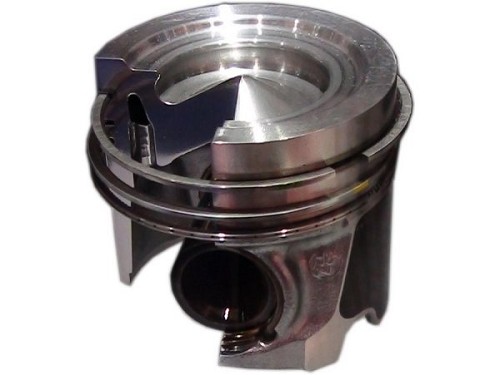
maintained. One can imagine how the outer shape, along with the grooves for the piston rings and the bore for the piston pin, is formed.
Things get interesting when the turning tool doesn't remain rigidly in place, but instead creates a certain degree of ovality through lightning-fast back-and-forth movements during a single
rotation. More recent measures are precautions against excessive blow-by gases or compression loss.
A groove located directly below the first piston ring helps the gases expand so they do not directly impact the second piston ring. Tiny grooves above the first piston ring create turbulence that
hinders the gases from moving further.
Of course, we also need to talk about the coating on the lower piston guide. The first thing that comes to mind here is iron, which has long been used in a specific process to ensure
the smooth running of an aluminum piston in a cylinder made of the same material.
A newer and more visible option are screen-printed coatings, such as those based on graphite. They are not so much intended for normal engine operation as for more extreme operating
conditions, and are likely to be quite worn out even after a long period of use.
So far, we haven't taken the forging pistons into account. These are caused by the continuous casting process commonly used for aluminum. The cast aluminum is immediately cooled with
water. Whether it is completely solid or only solid at the edges, it flows out of the mold downward as a long strand. Pieces corresponding exactly to the mass of the future piston are cut from it.
Forging is a process that involves both compression and shaping. Even though the diameter of the original solid blank is significantly smaller, pressing in several steps ultimately results in the
mold being completely filled. The subsequent processing is then similar to that of cast pistons.
Naturally, an indispensable element of industrial manufacturing is the final inspection, involving partial measurement and comparison, or, for individual units, a complete measurement and
comparison. Some parts can also be pre-assembled.
kfz-tech.de/YVe27
|