Piston speed Piston speed
Yes, interpreting data and comparing it is almost always worthwhile. It would be even better if, in the case of the aforementioned diesel engine, which has very low compression due to its design, would have the boost
pressure. And the boost curve would be even better. Then you could see at which RPM ranges excess pressure is reduced. As a substitute, the torque curve is not a bad choice and is usually available as well. As a
substitute, the torque curve is not a bad choice and is usually available as well.
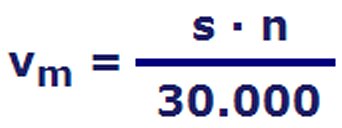
Well, hopefully that was still relatively easy. Now let's turn our attention to piston speed. A piston speed averaged over all movements of the crankshaft assembly is calculated using the formula:
Certain statements can be made about the strain on the engine caused by RPM. For a long time, 16 m/s was considered the threshold value. Anything above that could endanger the engine. Although there were some
well-known small Japanese engines that were said to run for hours in that range.
Of course, you can simply run an engine at a much lower RPM, but then you miss out on the enormously enjoyable performance that comes with a high-RPM concept. Today, thanks to advances in engine technology, the
limit stands at 20 m/s. Until recently, Formula 1 engines could reach speeds of up to 25 m/s, but that is now a thing of the past.
If you are interested in the piston speed at each point rather than the average speed, you must necessarily use the corresponding crank angle as the input value.

In a simple case, the crank angle is 90°, always measured from TDC. So, if we want to know the speed of the piston 90° past TDC, we set the sine (?) for ?=90° to 1 and the sine (2?) to 0. When you're at your computer, all
you need to do is open the standard calculator and select 'Scientific' from the 'View' menu. There, you can select the desired angle and click 'sin'.
Anyone who likes simplifying math problems will immediately see that setting sin² to zero makes the entire right side of the parentheses equal to zero. That makes sense, because if the piston is 90° before or after
TDC, its speed is exactly the same as that of the lower connecting rod eye, regardless of the connecting rod's length.
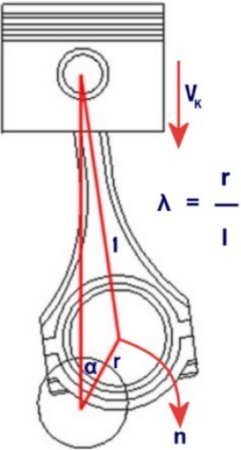
If we assume a stroke of 86 mm, r, the offset on the crankshaft, would be exactly half that, or 43 mm (see the top image). This gives a value of 1,620,240 mm/min from the remaining equation. If you divide by 1,000 and then
by 60, you get approximately 27 m/s for the piston speed exactly 90° before or after TDC.
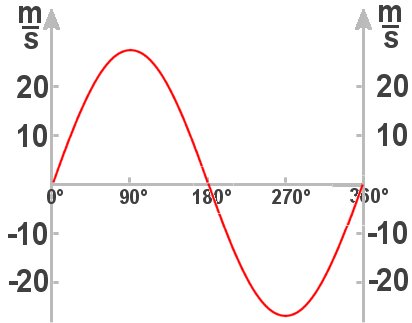
Here is the result of the calculation presented in graph form. The piston speed increases from zero to 27 m/s, which, when multiplied by 3.6, equals nearly 100 km/h. So the piston goes from zero to 100 in 21.5 mm. If it
rotates 6,000 times per minute, that's 100 times per second. That would be ten milliseconds (1/100 s) per revolution.
|