Map 2 Map 2
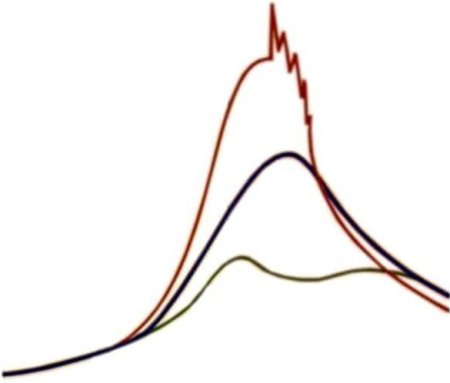
| From top to bottom: ignition too early, just right, too late |
We have now briefly touched upon a very important aspect. There is a kind of magic point in the ignition that has a particularly strong influence on the regulation. It is the point of knocking combustion. For example, it is also
the component that may force a retardation of the ignition despite an increase in engine speed. It has a lot to do with the compression, the shape of the combustion chamber and the arrangement of the associated parts.
Knocking combustion is the enemy of petrol engine mechanics. It occurs when a second flame front forms somewhere in the combustion chamber during the combustion initiated by the spark plug's electric arc. One must
imagine this as if the aforementioned radicals did not encounter molecules that are slow to react, but rather radicals that have also already been formed by the second flame front.
The result is initially a sudden increase in pressure, which may be accompanied by a knocking or ringing sound. If this only occurs for a short period of time, it usually has no devastating effect. The old VW boxer engines
could make such noises if nevertheless you gave full throttle in too high a gear. There was a slight clatter, and that was it.
This case is classified as so-called 'acceleration knocking'. It is also not so tragic because it is usually audible despite the driving noise. The natural reaction of most drivers
then silences it. Much worse is 'high-speed knocking'. It is unable to drown out the increased driving noise.
When knocking, it is important to distinguish between mechanical and thermal damage. So, a defective bearing on or near the crankshaft belongs to the first category, while burnt valves or pistons belong to the second. It is
usually enough to cause serious engine damage. Incidentally, this could also happen in the past if, due to a lack of lubrication, the flyweights remained completely extended, even though they
should have returned due to the lower speed.
Now, of course, you may ask the legitimate question of why anyone would want to be anywhere near a knocking engine in the first place. One could set the ignition so far towards late that the temperature in the combustion
chamber remains nicely low and knocking combustion would not be possible in principle.
This line of thinking would undoubtedly be correct if it weren't for the caveat that both fuel consumption and performance, as well as exhaust emissions, would suffer as a result. To cut a long story short, the petrol engine
has the best efficiency near knocking combustion. And it is appreciated by both performance enthusiasts and fuel savers.
What to do? Once again, electronics come to the rescue in the form of a knock sensor. You may know that it contains particularly thin layers of piezo crystal, which either expand very slightly with great force when voltage is
applied, or conversely release such voltage when vibrating. If you screw them onto the engine block with the correct torque near the expected knocking point, you can make this detectable for the electronics.
That sounds easier than it is. The electronics must first learn to distinguish between normal vibrations of the engine block and irregular ones. In addition, the sensor must be close enough. As a rule, more than one knock
sensor is required for engines with more than four cylinders in line or even V or boxer engines.
But then the whole installation is a fabulous help. If knocking occurs anywhere, the engine management system knows exactly which cylinder is misfiring because of the ignition command it has just generated. Even
before it is used again, the control unit has reduced its ignition timing by, say, 3°. If it is still knocking there, the procedure is repeated.
Now, the late ignition on one cylinder cannot be allowed to get too much out of hand. That would be like running the engine on one cylinder less. Therefore, if the fault persists, the ignition will also be retarded for the other
cylinders. Incidentally, instead of retarding the ignition, the map can also be replaced.
Here, electronics can really let loose, even more so than before, to the benefit of drivers. In the past, when the engine was cold and therefore running at low revs, the ignition was set to a value somewhere between 10 and
20° before TDC. In cold weather, the risk of self-ignition and the associated knocking combustion is much lower.s
So what does the ignition do? It continuously advances the ignition timing. If it is a learning (adaptive) system, it can even readjust the starting point of this control cycle repeatedly over the course of an engine's lifetime.
Because one thing is important: it must not be allowed to use its natural speed, but must be artificially slowed down considerably.
After all, such a system must not overreact. Mechanics and thermals need a certain amount of time to adjust to changed conditions. But if the ignition timing is set to 50° before TDC or even earlier, you can expect both
better torque and a certain reduction in the previously high cold running consumption.
|