|
| 
|
 Driving school 1 Driving school 1
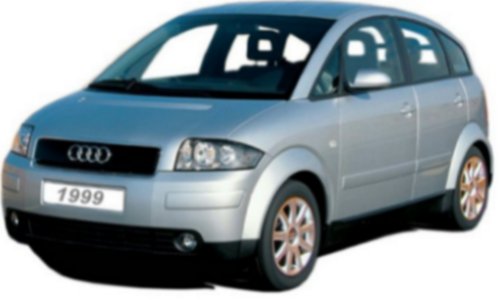
| Still a model of efficiency: the 3-liter Audi A2 |
So if you're driving around in a normal gasoline-powered car without direct injection, over 70 percent of the energy is already lost before the power reaches the transmission. On the way to the drive wheels, losses are
added up for the transmission, axle drive, wheel bearings, and wheel ventilation. With a manual transmission, this represents a loss of around 2 percent, and significantly more with a torque converter automatic
transmission.
If we consider rolling resistance and air resistance, both are still roughly equal in a normal car traveling at around 50 km/h. After that, air resistance increases with the square of the speed. This means that we mainly need
engine power on the highway, for example, to overcome air resistance. Would you have thought that only about 4 kW is needed to drive a modern car at 50 km/h on a level road?
Incidentally, despite or because of our wastefulness, we will never again carry energy with us as concentratedly as we do now. Let us return to the aforementioned calorific value of diesel fuel, which is 42,800 kJ/kg. At the
aforementioned 0.83 kg/dm³, that would be 35,524 kJ per liter, divided by 3.6, approximately 10,000 Wh or 10 kWh. Just for comparison, a BMW i3 has 42.2 kWh when fully charged, presumably a gross value.
The weight of the batteries is specified as 230 kg. The energy content corresponds to less than four liters of diesel fuel. Now you can guess how much a tank containing just under 4 liters of fuel would weigh. Not to
mention the time spent at the 'gas station', which can take up to 8 hours (household connection) with BMW. You can probably guess why many customers are currently researching electric cars intensively, but end up
buying a diesel.
No, we mustn't be so negative about electric cars. When it comes to utilizing the energy that has been laboriously generated, it cannot be surpassed, at least not by the combustion engine. Let's take
the range of 260 km specified by BMW in a not too hot summer as an exception. This car achieves a fuel consumption of just 1.5 liters per 100 km.
Now you might argue that a vehicle with a combustion engine from VW has already achieved this. That's true, and also not true. Because the crucial difference is that it was a super-expensive prototype. Its single-track
design is particularly important, as it significantly reduces air resistance and the need for an additional battery. It was powered by a weak diesel engine, which was nothing like the powerful BMW engine.
Yes, there are improved successors, but the combustion engine is still struggling to catch up with its electric counterpart. However, there is a world championship in which vehicles with bicycle tires, between which you lie
down, try to travel as far as possible on one liter of fuel. They ride cycles, accelerate gently, and then let them roll. The record is equivalent to more than 3,000 kilometers.
What does this tell us? It reminds us of our wasteful use of fossil fuels and highlights the important factor of air resistance. It also identifies sailing as the more suitable form of energy saving, even ahead of recuperation.
However, you can already do a lot for the environment and your wallet by easing off the gas pedal a little on the highway.
|
|