|
| 
|
 Lubrication - Distillation
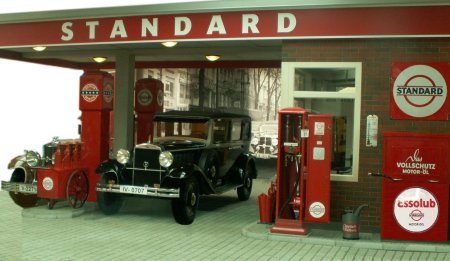
A typical example of distillation is heating a substance to its boiling point and then cooling it. An experiment in which crude oil was heated to just 30°C proves that this does not necessarily have to occur at high
temperatures. Yes, even during that process, a gas is produced that can be captured, but it must be cooled using specific techniques.
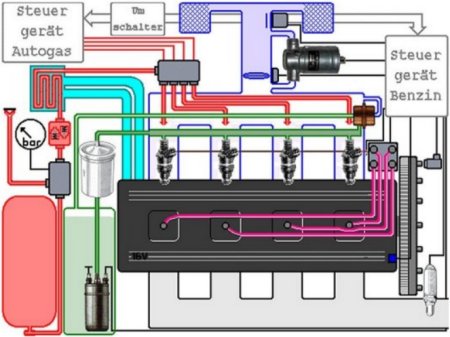
You're all familiar with this, whether you're a smoker or occasionally rely on camping gas. It remains liquid in the lighter or gas cartridge only because it is kept under pressure. As a fuel for internal combustion
engines, it is known as a mixture of propane and butane under the names 'autogas' or 'LPG' (picture above).
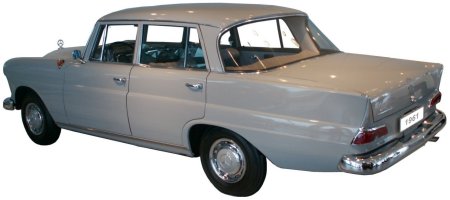
Up to 180°C, all crude gasoline becomes a gas; this time, it turns liquid simply by cooling. Up to 250°C, it becomes petroleum or kerosene for airplanes, and up to 380°C, it becomes diesel or heating oil. Gasoline
and diesel can each account for a quarter, while kerosene accounts for slightly less. Certain vintage diesel cars (pictured above) are even still allowed to run on kerosene.
| A wide range of octane ratings at a U.S. gas station: |
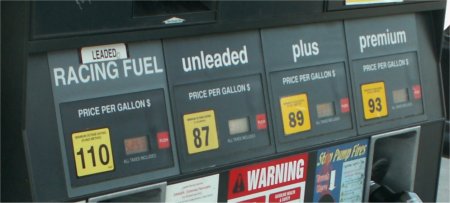
However, you shouldn't pour raw gasoline into the tank of a classic car, at least not without mixing it with large amounts of gas station gasoline. What is missing is the very basis of the
term ‘raffinerie’, which comes from French: refinement. For example, the octane number is so low that it is also referred to as 'bell water'.
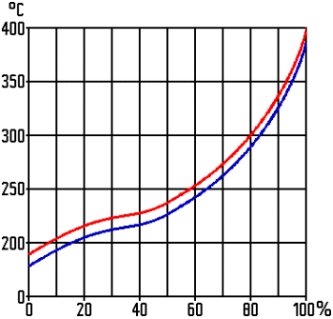
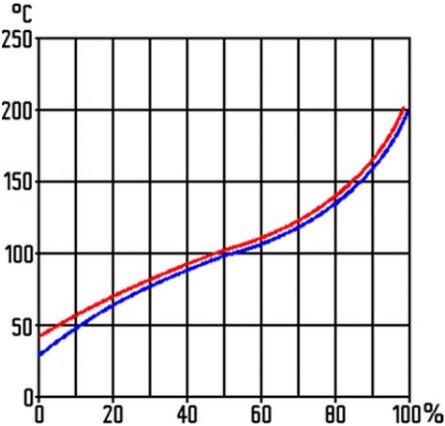
Here you can see the boiling range of diesel once again. Most people know that the diesel sold at gas stations in the summer is different from the diesel sold in the winter. What may be less well known is that
summer and winter gasoline also differ (see image below), though to a slightly lesser extent.
Actually, we've already carried out a certain degree of separation based on boiling point (distillation). At the refinery, this takes place in a fractionation column. There, crude oil with a density between gasoline and
diesel (bottom left) is fed through the indicated tube furnace and, at a temperature of approximately 370°C, is first sent to atmospheric distillation. Superheated water vapor is added from below.

The liquid portions of the crude oil settle at the bottom. The rest rises through what are known as bell-shaped bottoms. The higher up you go, the more the heat subsides; condensation there and the accumulation
on the individual floors provide the necessary separation. So here, too, over 500 different molecules are mirrored in terms of structure and number of atoms; the larger they are, the more viscous they are.
| There is also crude oil that flows only when heated. |
Three columns are shown here because there can be two different temperatures in atmospheric distillation and another in vacuum distillation. Here, the residue from the previous stage is broken down even further
into, for example, bitumen for roofing and road construction, heavy fuel oil for ships far out at sea, and a whole range of lubricants.
However, diesel also has lubricating properties, which is why it is sometimes called diesel oil. Just not gasoline, it tends to wash away lubricants, it used to be used in workshops to clean parts. So one could
classify diesel as a light oil. In addition, there are medium and heavy oils, all of which can presumably be used as fuels, albeit with considerable effort, for example, by heating them to 50 to 60°C.
While the materials that have already been separated are transformed through 'cracking' into smaller hydrocarbon structures and, when recombined, form many of the plastic items we use in our daily lives.
This is how the actual lubricants are obtained from what is known as the 'residue' in vacuum distillation. Lighter components are removed using solvents, resulting in, for example, spindle oils, cylinder oils, and
heavy oils.
|
|