|
| 
|
 ACEA Standard
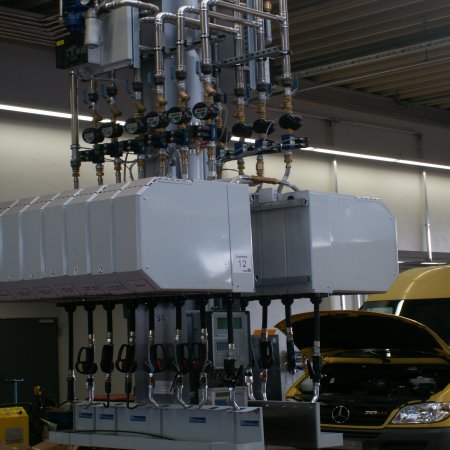
Sophisticated oil dispensing system
at a truck repair shop
One of the many standards is that of the Association des Constructeurs Européens d'Automobiles. This association of European automobile manufacturers classifies oil according to
the following categories:
| A | Passenger Car Gasoline Engines |
| B | Passenger Car Diesel Engines |
| C | Passenger Car Diesel Engines, Particulate Filter |
| E | Truck Diesel Engines |
The number following each letter indicates the quality rating:
| A1/B1 | Low-friction motor oils with HTHS viscosity below 3,5 mPas |
| A2/B2 | Standard motor oils with HTHS viscosity above 3,5 mPas |
| A3/B3 | Premium motor oils also for extended service intervals |
| A4/B4 | Premium motor oils such as A1/B1, but designed for extended service intervals |
The High Temperature High Shear viscosity in mPas (millipascal-seconds) indicates the dynamic viscosity at 150°C and under more stringent requirements for
shear stability. The standard defines a threshold value of 3.5 mPas, below which additional fuel savings are possible.
In this context, it should be noted once again that all oils available today must be miscible with one another, meaning that you can easily switch brands and even grades, even when refilling. On the
other hand, however, it is important to keep in mind that even when all the oils in a motor vehicle are replaced, the savings are relatively small. Corresponding experiments showed, for example, results
of only 1 to 2 percent.
Class C has become increasingly important in the field of exhaust gas treatment. This now applies not only to diesel engines but also to gasoline engines, which are increasingly being equipped with particulate filters.
This refers, for example, to low SAsh Phosphorus Sulphur oils. In addition to catalytic converters and SCR systems, particulate filters are primarily affected.
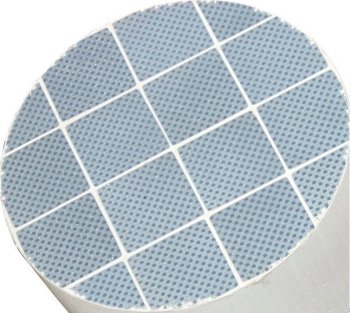
In a particulate filter (pictured), the channels are open on only one side, which means that the exhaust gas must pass through the sintered material, leaving any ash behind. Some of this remains even after
the filter has been regenerated, which means costly removal and reinstallation - and possibly even replacement. An oil with few ash-forming components extends this period accordingly.
| C1 | HTHS viscosity below 2.9 mPas, very low sulfate ash, P and S |
| C2 | HTHS viscosity above 2.9 mPas, higher sulfate ash, P and S |
| C3 | HTHS viscosity above 3.5 mPas, even higher levels of sulfate ash, P and S |
|
|