Rim damage 2 Rim damage 2
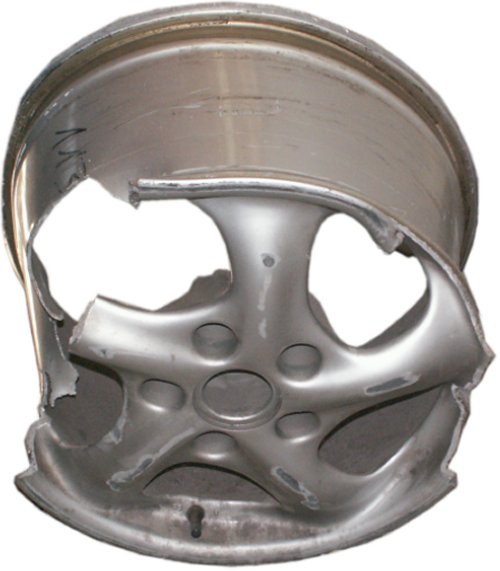
It’s safe to assume that even the experts in the video below wouldn’t try to rebuild this rim again, but would instead melt down the material. Still, it’s really
amazing what they’re able to accomplish. But first things first: In Germany, you won't be allowed to drive again with a rim repaired in this way.
Below you can see an even more impressive machine, because it’s also suitable for our climate. I actually saw a machine like that a while back at a trade show in Cologne and was really impressed.
The rim, which had been machined, looked even worse.
Until now, I was only familiar with wheel machining in cases of runout issues, specifically, in this context, vertical runout. Here, machines operate fully automatically, but it takes them forever to
detect deviations and correct them using hydraulic pressure.
Hydraulics are at work here as well, but they also affect the force with which, for example, the rollers push the rim flange back into the correct position. This is a machine designed for
workshops and small repair shops.
It can process rims ranging from 10 to 19 inches and has a maximum hydraulic pressure of 200 bar. Consequently, it requires three-phase power to operate. The
hydraulically pressed rollers shown here are used only with steel rims.
Of course, in Germany, using a machine like this is only worthwhile for rare, expensive rims, such as those with an unusual width. Steel is elastic and tough. Aluminum
is likely to crack if subjected to the kind of treatment described above.
Even worse is when hairline cracks form in aluminum. Such a machine operates solely using controlled hydraulic pressure, not via the rollers. It also depends
on whether the rims are just cast or also forged.
Cast rims are said to have a coarser grain structure, which could further contribute to cracking. Forged rims have an advantage here because they can be straightened more easily, even under
heavier loads.
Uni-Trol also offers models capable of processing larger rims up to 30 inches, working with digital measurement and hydraulic quick-release technology. For machines like these,
however, a repair shop needs to have enough potential customers.
We do not receive any advertising revenue from Uni-Trol. In addition to the major companies, there are also the Italian firms Zero Innovation and FASEP. Wheel-straightening machines can also
be combined with milling units for further surface finishing.
|