|
| 
|
 Tire Disposal Tire Disposal
kfz-tech.de/YRa16
Disposing of old tires isn't really a problem. Usually, you can drop them off at the same place where you buy or have your new tires mounted. Tires sold online, unless they're mounted directly on rims,
are a problem anyway.
Installing it yourself, for example, using a tire iron, is already a challenge. It's easy to damage the rim or the tire, too. When it comes to balancing and the possible need to
calibrate the pressure sensors, that's where the fun finally ends.
On the other hand, the issue of disposing of used tires without buying new ones is an interesting one. Prices here range from €5 and up to a more realistic €1 to €2 per tire in revenue, if
you look around and find the right shop.
In general, proper disposal is very important. Every year, more than 650,000 metric tons of scrap tires are generated when you add up the tires from all vehicles, which of course also includes, for example, bicycles and
airplanes.
It is incomprehensible that illegal disposal is on the rise under such circumstances. There are approximately 150 reported cases in Germany. Yet there are plenty of disposal options: export, retreading,
material recycling, thermal recycling, or chemical recycling of the components.
| Please keep the proof of proper disposal.
|
However, the legal regulations, including specific recycling quotas, are putting pressure on waste management companies. This includes any low-cost providers as well, such as those from
abroad, too. In any case, the relatively simple conversion into sports equipment no longer seems to be allowed.
Large-scale illegal disposal -> Fines of
up to 100,000 euros. |
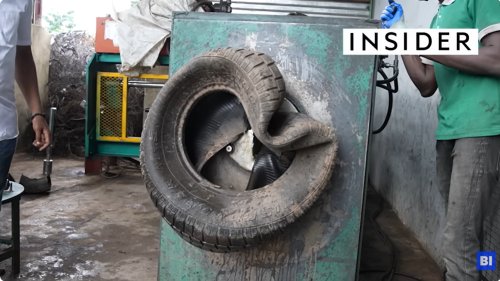
An ambitious goal for recycling would be for a tire not to be cut into pieces and incinerated, nor converted into products that are, in principle, of lower quality, but rather for
as large a proportion as possible to be turned back into a tire.
After all, anything else would mean that the recycling process would eventually lead to incineration anyway. One way to achieve this is, for example, through fine grinding. It can then produce fine flour
down to a thickness of just 0.4 mm.
In that case, one can truly assume that, for example, rubber or carbon black, steel, and textiles are precisely separated from one another and, once collected, can be reused as components of a tire.
Fuel has even been produced from recycled tire parts, a very complex process, but possible.
After all, on average, a tire consists of 45–50% rubber (natural and synthetic), 20–25% carbon black, 15–20% steel, and 5–10% textile. It's easy to see that, if you
can separate them from one another, these are essential raw materials.
And if that takes energy, then the sooner we can ensure a supply of renewable energy, the better. At some point, this will be free of charge, except for minor maintenance costs.
kfz-tech.de/YRa27
|
|