Porsche engines 1
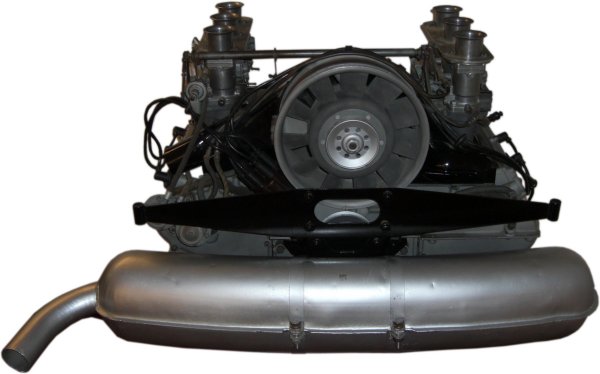
No, we don't want to repeat all the data here, nor do we want to start with the so-called 'Mezger' engine, that is, the six-cylinder model introduced in 1963. We'll also leave out external features such as carburetors and
mechanical fuel injection.
So we're talking about the engine block, which is always a bit of a temperamental affair with boxer engines, especially when it's air-cooled. And compared to the original Beetle, it has actually become even more
fragmented. In addition to the individual cylinders, Porsche also offers these types of cylinder heads.
What is particularly interesting about this are the angles between the valves and their significant influence on the design of the combustion chamber. In the first four-cylinder engines, even the angles of the valve stems
relative to the centerline of the cylinders play a role.
That's where the exhaust valve breaks out significantly, whereas in the Fuhrmann engine, it is somewhat captured again. But let's take a look at the six-cylinder engine and note that we're once again moving closer to the
small angle between the valves.
Hans Mezger himself confirmed, according to ChatGPT, that performance increased and fuel consumption decreased as a result. Ultimately, the design settled on 27° for the intake valve and 33° for the exhaust valve, a
configuration that remained unchanged until the end of the air-cooled engine era.
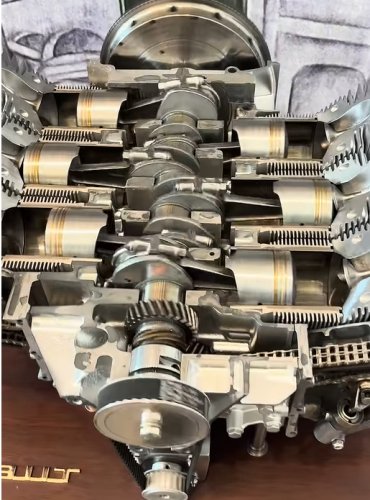
Changes like these are still within reason, but installing a crankshaft with eight main bearings into a six-cylinder boxer engine is certainly worth a special mention. And why eight bearings when there are 'only' six cylinders?
With the eighth bearing - which, incidentally, was not yet present in the first prototype engines - an attempt was made to keep the distances between them as uniform as possible. So it was probably due to vibration-related
reasons, as part of the preparation for higher rotational speeds later on.
Actually, the major change in the cylinders, from Biral gray cast iron liners to magnesium ones, didn't take place until 1969. But presumably for cost reasons, the 1967 911 T still had ones made entirely of gray cast iron.
Cost considerations may also have played a role in the design of the dry-sump lubrication system. Instead of the 8 liters in the Fuhrmann engine, only 3.9 liters are stored here, meaning that a good 5 liters are kept in
circulation, a very mild form of this type of lubrication.
The return and feed pumps in the first 911 models are gear pumps. There are also slightly fewer suction points than usual - specifically, one oil suction strainer on the left and one on the right. It seems
that this was a kind of 'light' dry-sump lubrication system.
Let's briefly touch on the shortcomings of this type of engine. Other engines also have shaft seals that can leak, but they have fewer seals and fewer sealing surfaces. A certain amount of oil in the water is therefore often
considered typical in older 911 engines.
The two-part design of the innermost engine block and the air cooling system present particular challenges. In addition, there were oil leaks on the covers and, in the 911, excessive wear on the valve guides. But
the engine isn't particularly prone to breakdowns.
|