|
| 
|
 Ferdinand Porsche 1 Ferdinand Porsche 1
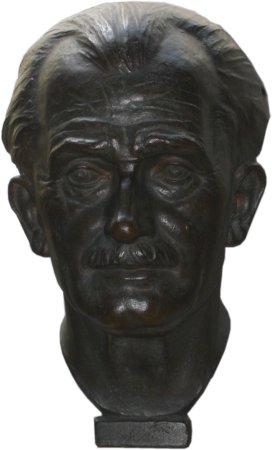
He was born in Maffersdorf in 1875, the middle child of five. Today, it is called Vratislavice nad Nisou and is located in the Czech Republic, 50 km northeast of Mladá Boleslav (Škoda) and a good 100 km
northeast of Prague. At that time, it was part of the vast territory of Austria-Hungary, which bears no resemblance whatsoever to today’s Czech Republic. Austria-Hungary, the Austro-Hungarian Empire, was so
large
that it even extended as far as Trieste, on the Mediterranean Sea.
His father ran a plumber's business with several employees, a term that doesn't quite capture the modern concept of a plumber, as it involved more metalwork than just that required for water supply
and heating. In the village, the father held various offices and was likely considered one of the local dignitaries. After his older brother's death, young Ferdinand learned his father's trade, but he was far more
interested in the emerging field of electrical engineering.
Anton Porsche viewed his son's interests with skepticism until one day his house became one of the first to be equipped with electric lighting, not, of course, connected to the public grid, but powered by its
own generator. Apparently, there was even a kind of entrance intercom system. Apart from elementary school until the age of 14 and then (evening) classes at the trade school in Reichenbach, Porsche never
received any formal theoretical education.
His apprenticeship at his father's company was followed by one at Vereinigte Elektrizitäts-AG Egger in Vienna (later Braun Boveri), during which he attended evening courses at the Vienna University of
Technology as a sort of auditor. After completing his apprenticeship, Porsche became head of the test room and, at the age of 22, assistant to the plant manager, his first management position. That same
year, he filed
his first patent for the electric wheel hub motor.
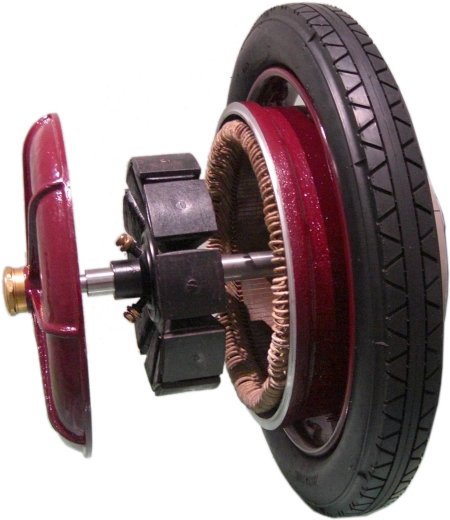
kfz-tech.de/PVW18
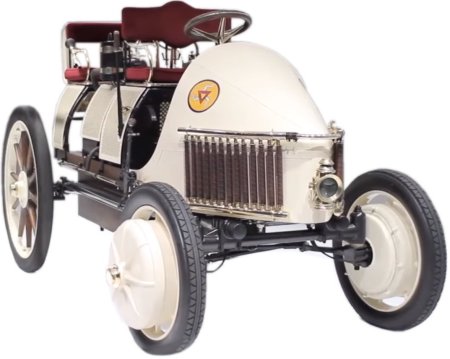
Before joining Lohner-Werke as chief designer in 1898, he met Aloisia Kaes while working at Egger, and they married in 1903. At Lohner, he built the Lohner-Porsche, which had already won an award at the
1900 World’s Fair in Paris, a car with two hub motors (pictured above) in the standard version and four motors in the racing version. The batteries proved to be so heavy and underpowered that they were
replaced by a gasoline-electric (hybrid) powertrain.
kfz-tech.de/PVW19
| Replica of the Semper-Vivus hybrid vehicle |
Porsche itself competed quite successfully in races. Luise was born in 1904 and Ferdinand (Ferry) in 1909. Both also played a significant role in the establishment of the Volkswagen plant. In Vienna, the
family lived in the same street as Siegmund Freud. At the time, Adolf Hitler was still an unemployed painter, but he was also in town. While working at Lohner, Porsche came into contact with the highest
circles.
kfz-tech.de/PVW110
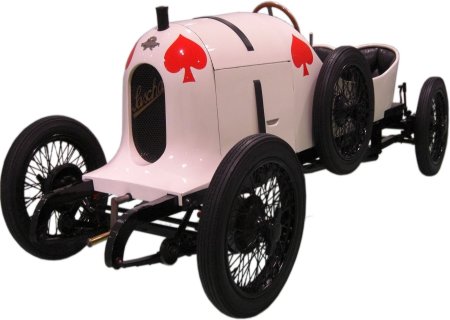
| Sascha's car for Count Kolowrat |
Porsche, who was also honored with imperial distinctions, went on to become a designer for a wide range of applications. In 1906, Lohner moved to Austro-Daimler as chief designer, where he designed
everything from fire engines, which, incidentally, still had to be pulled by horses, to aircraft engines, trolleybuses, transport systems, and military equipment, such as a towing train for gun carriages (mobile
artillery pieces).
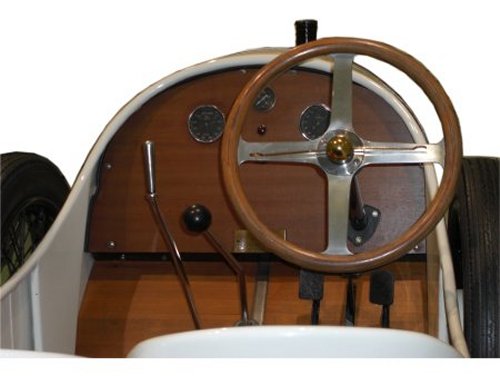
kfz-tech.de/PVW111
| The modest dashboard of the Sascha car. |
However, Porsche's work also meant increased costs for his employer, which the company could no longer afford or was no longer willing to bear. Camillo Castiglioni, who also served on the supervisory board
of Austro-Daimler, is said to have once remarked about Porsche: 'You can hire Porsche.' He's a very brilliant man. But listen to my recipe. You have to lock him in a cage with seven locks. In it, he is supposed
to draw his engines. And he should hand you the engine drawings through the bars so that, for heaven's sake, he can't get his hands on the drawings or the engine again. "This is my recipe. I'm giving it away
for free, even though it's priceless". (Citation: Stiefel: Camillo Castiglioni, 2012)
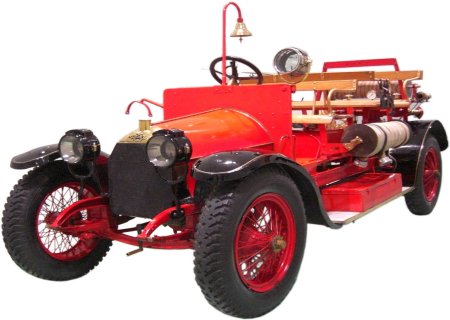
kfz-tech.de/PVW112
| Fire truck designed by Porsche |
Porsche also remained successful as a race car driver. Although the Prinz-Heinrich-Fahrt, which he won in 1910, shouldn't really be called a car race. It was more of an endurance test over long distances
(nearly 2,000 km in 1910) with built-in speed tests. Racing cars were not allowed either; only touring cars, each carrying three people.
In addition to the inevitable controller, the 18-year-old Croatian Josip Broz Tito, who would later become the long-time head of state of Yugoslavia, is said to have been a co-driver. Not only had Porsche won the
1910 Prinz-Heinrich Race, but it was also declared the overall winner of all three races starting in 1908 by a drawing of lots.
The Sascha car (pictured above), which was being developed at Austro-Daimler, was considered important for the development of a Volkswagen. On the surface, it was a commissioned work for Count Sascha
Kolowrat, but it clearly demonstrated Porsche’s move towards a small car that was affordable to more people than ever before. Although the car had a small engine by the standards of the time, 1,100 cm³
3, it was exceptionally successful in races thanks to its light weight and 33 kW (45 hp).
Differences of opinion with the supervisory board regarding the distribution of profits, either to shareholders (Castiglioni) or as an investment in the company (Porsche), and the company’s future direction during
the difficult period following World War I led to the split and the move to Daimler in Stuttgart in 1923. That same year, Porsche bought a villa in Stuttgart-Feuerbach for himself and his family.
Among other things, he was responsible for the further development of the famous supercharged engines at his new employer. In 1924, the University of Stuttgart awarded him an honorary doctorate, as had
been done in Vienna in 1917 already. Whether it was the 'tense situation', the aftermath of the 1926 merger with Benz, or Porsche's supposedly 'laid-back management style', he resigned in 1928. The real
reason was that during a spectacular test in the winter, most of the new cars provided failed to start.
The board blamed him, and he, in turn, blamed the purchasing department, which he believed had procured batteries of insufficient quality. A year followed at Steyr-Werke, which, facing financial difficulties,
was taken over by Austro-Daimler. It was a time when the infamous "Black Friday" of 1929, with its stock market crash, had a significant impact on Europe as well. Porsche started his own
construction office.
Those must have been difficult times for the company, which was founded in 1930. In the meantime, his daughter Luise had married the Viennese lawyer Anton Piech, who acquired a 15 percent stake in the
new company, as did Adolf Rosenberger. The fact that he was of Jewish descent became significant during the subsequent Nazi era. Twelve trusted employees from
Porsche's previous company joined the firm, as did Ferry Porsche after completing a one-year apprenticeship at Bosch.
|
|