|
| 
|
Flywheel
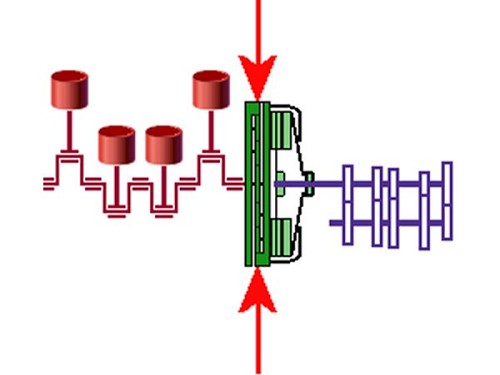
The primary flywheel is connected to the engine,
and the secondary flywheel is connected to the
transmission. |
kfz-tech.de/PKp59
Primary tasks
The flywheel stores kinetic energy and helps the crankshaft overcome dead strokes and dead centers in engines with fewer than four cylinders. As the strain increases, it ensures a slower decline in the engine's
performance. The dual-mass flywheel also reduces torsional vibrations between the clutch and the drivetrain.
kfz-tech.de/PKp60
Secondary tasks
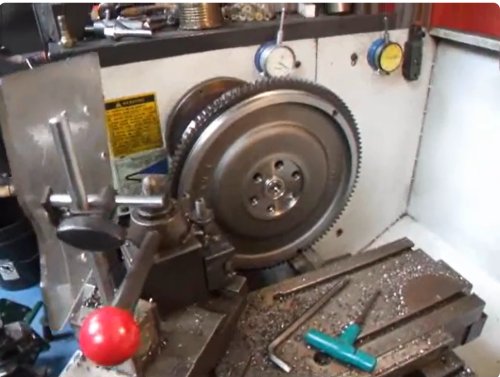
The flywheel houses the clutch; in fact, it is part of it. The externally shrunk-on gear ring is essential for proper starting function. If it is damaged, the starter pinion will not engage properly at the start of the starting process or
will not disengage at the end.
In the past, the flywheel also had notches for adjusting the ignition timing. Later on, this also included various specific material accumulations, for instance, to serve as an impulse generator for the electrical TDC sensor. In
the age of inductive sensors, a sheet-metal gear ring may still be found here and there. Here, the crankshaft position is measured with slightly greater accuracy than at the V-belt pulley because the
diameter is larger.
| Assembly (sectional view) |
kfz-tech.de/PKp61
Function
A round metal disc, heavier on the outside, is attached to the crankshaft on one side and connected to the transmission (axle drive) via the clutch on the other. It dampens torsional vibrations and helps the reciprocating
engine overcome dead centers. In four-stroke engines with fewer than four cylinders, it provides sufficient inertia for the dead strokes. This effect is all the greater the farther outside the flywheel masses are mounted. Light
flywheels are suitable for very sporty engines, while heavy ones help maintain engine speed on hills when the power-to-weight ratio is high.
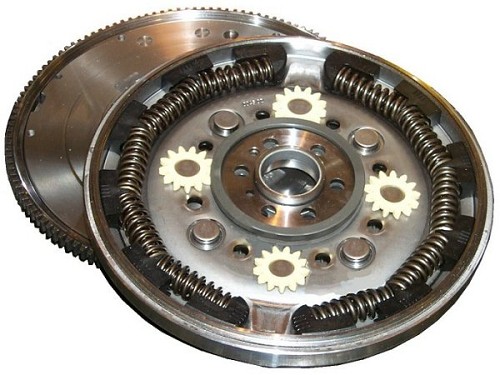
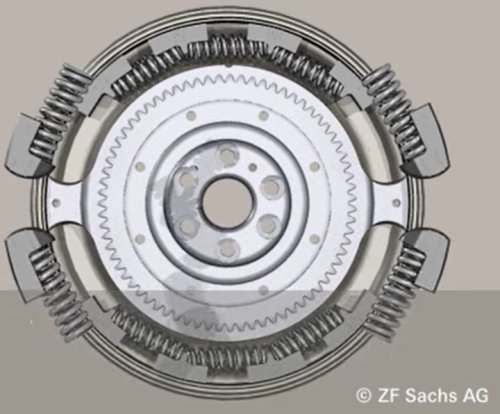
As a dual-mass flywheel (see image), it is divided into two parts. One part continues to influence the crankshaft's vibration behavior, while the other helps prevent resonances in the transmission and the rest of the
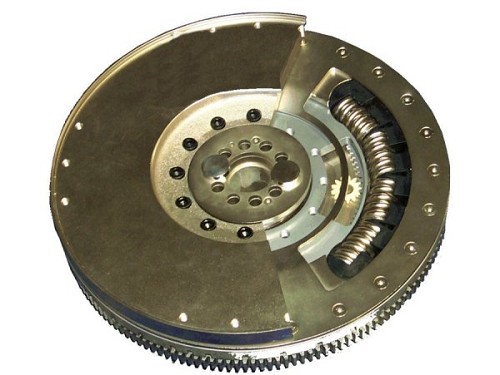
drivetrain. Both are connected to each other by internal coil springs (image) and/or gears. In that case, the torsion springs in the clutch disc might not be necessary. Figure 3 shows the complete (cutaway) dual-mass
flywheel with the additional planetary gearset.
There are various ways in which vibrations can occur. These are torsional vibrations caused by the ignition system, particularly when there is uneven torque distribution in the diesel engine or significant
load changes resulting from operation. They are damped by assigning a flywheel mass to the oscillating parts and decoupling them from the drivetrain.
kfz-tech.de/YKp36
kfz-tech.de/YKp35
|
|