|
| 
|
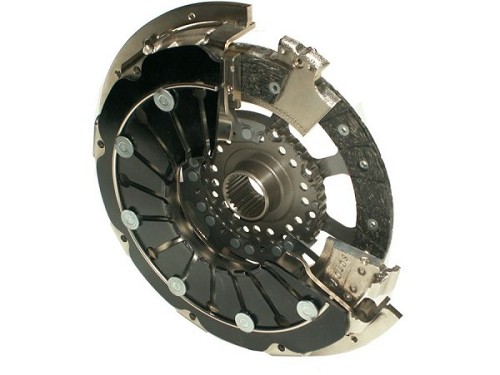
Clutch 1
kfz-tech.de/PKp20
| Clutch: Force-fitting connection between rotating components |
| An incredible number of clutch variants |
The clutch can be engaged/disengaged by mechanical, electrical, or hydraulic components. It is necessary for starting and shifting gears. You can even stop (not for too long!) without having to put the gear in neutral.
Starting is smooth thanks to a clutch without jerking, and if the drive train is overloaded, there is the option of a predetermined breaking point. When disengaged, the clutch transmits torque with almost no loss.
When engaged, the clutch transmits torque with almost no loss.
| Foot-operated clutch on the retreat |
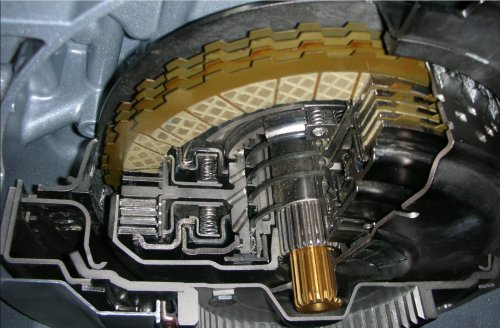
One group of components is usually connected to the crankshaft so that it cannot rotate, while another is connected to the transmission drive shaft so that it cannot rotate either.
kfz-tech.de/PKp21
The connection between the two is triggered by the foot pedal and, in newer models, increasingly automatically. Friction and electromagnetic clutches operate without slip when engaged. In this respect, they differ
fundamentally from connections in which the torque is transmitted by hydraulic oil.
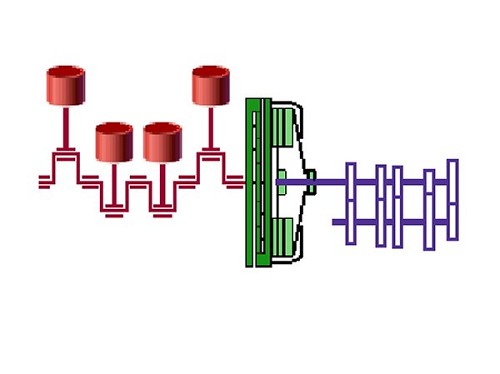
| Engine, clutch, and five-speed transmission |
kfz-tech.de/PKp22
Single-disc (diaphragm spring) dry clutches are now installed in passenger cars and most trucks. In these vehicles, the clutch is disengaged by pressing a pedal. Construction machinery also has clutches that are
engaged by pressing a button. In planetary transmission systems, a torque converter usually replaces the clutch.
| Other clutch designs |
| Hydrodynamic clutch |
| Magnetic powder clutch |
| Visco coupling |
kfz-tech.de/YKp13
kfz-tech.de/YKp14
|
|