|
| 
|
Direct-shift gearbox 1
| 2 x multi-disc oil bath . . . |
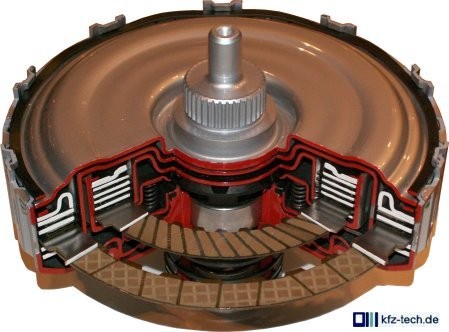
kfz-tech.de/PKp2
The classic automatic transmission now has some competition. Sequential transmissions are taking the market by storm. While they don't quite match the ease of shifting, they do outperform
fully automatic transmissions, particularly in terms of efficiency. Thanks to the dual-clutch systems pictured above, they achieve a shifting speed that makes them particularly attractive,
especially for sporty vehicles. And they are almost as compact as conventional friction clutches.
Dual-clutch transmission
for
faster shifting |
However, since the clutch engages automatically, friction variations should be minimal, for example, when reversing, to protect the driver from sudden acceleration and, consequently,
uncontrollable behavior. Modern engines also generate such high torque right from the moment they start moving that this places special demands on the clutch. Direct-shift transmissions are
designed for a broad market, ranging from fuel-efficient to sporty models, in order to keep production costs down by maximizing production volumes.
| 2 x single-disc dry . . . |
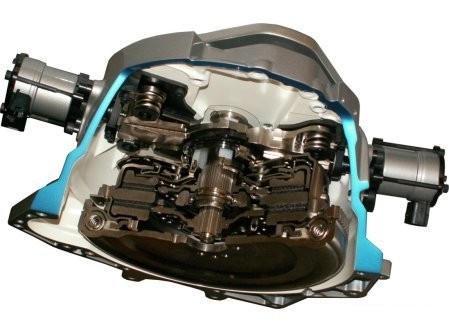
kfz-tech.de/PKp3
There are clutches with completely dry friction linings (Figure) and those that operate in an oil bath (picture 1). These are also called wet clutches. They generally have a slightly larger friction
surface while maintaining the same maximum torque requirement. What is interesting about the image above is that the inner clutch, which has the smaller diameter, has the greater number of
plates. Until now, multi-plate clutches have been found almost exclusively in motorcycles and automatic transmissions, but they are now spreading to the rest of the four-wheeled vehicle
segment as well.
Dual-clutch transmission
is typically used in
automated manual transmissionsS |
However, while conventional wet clutches in two-wheeled vehicles are usually operated manually and run continuously in oil, resulting in corresponding drag losses, in cars they work in
conjunction with an automated manual transmission and, very rarely, in fully automatic transmissions in place of the torque converter. They extend and retract upon command from a control
unit-hydraulically (Figure 1) or electrically (Figure 2).
Modern wet clutches
with virtually no
drag losses |
Wet clutches are currently preferred because their oil circulation system dissipates the heat generated more quickly. New oil is supplied only for as long as the clutch engagement process
lasts. When driving at a constant speed in a single gear, there is no oil bath to prevent drag losses. This design can therefore compete with the dry clutch even in the main operating range. Of
course, the brake pads in the two systems are not the same, but the otherwise slightly lower coefficient of friction of the wet pads is sufficient once the clutch is engaged.
Since the clutch has been automated, the possibilities have expanded. This means that, much like with construction machinery, hydraulic or electrical power can be used to either open or
close the mechanism. Assuming that the vehicle is frequently driven in the highest gear, the two clutches can be designed so that one is open and the other is closed when no power is being
supplied. Manufacturers typically design both couplings identically. One interesting feature is the ability to operate both clutches simultaneously via a hydraulic or electric actuator.
|
|