Thermodynamics 5 Thermodynamics 5
First, we will explain the concept of enthalpy once again. We had previously described it as a form of energy. It is important to note that this type of thermal energy is no different from any
other form of energy, all of which are also measured in joules. One joule is the amount of heat required to raise the temperature of 1 gram of water by 1°C at normal pressure. We'll skip the
detailed figures here.
The unit kJ/kg was then derived from the specific enthalpy relative to mass. Incidentally, the term comes from Greek and can be interpreted as 'heat content'. We will stick with the definition of
energy as internal energy and, in accordance with the first law of thermodynamics, divide it into thermal (heat) and mechanical energy (work).
Based on the model of molecular vibrations developed earlier, the total energy of these vibrations is somewhat related to enthalpy. If we assume that the given oscillations represent the zero
point of energy, then this energy can be increased in two different ways.
If a warmer body is directly connected to this medium, the higher frequency of the more vigorously vibrating molecules is transferred to the molecules of the medium at the interface, causing
their vibration frequency and thus their temperature will rise. However, if the enthalpy is to be increased solely through heat transfer, the rise in pressure must be compensated for by an increase
in volume.
Which brings us to the increase in enthalpy due to mechanical work. Here, the system boundary is shifted, which also affects molecular motion. The vibrations, and thus the temperature, increase.
Sure, when you apply pressure to a gas, it gets hotter. This causes the enthalpy to increase. It can therefore be influenced by direct heating or work of volume change.
The issue of humidity is closely related to that of saturation. Here, too, it is advisable to start from an initial state. Imagine a glass of water in an air-filled room. Water molecules are arranged in a much
tighter structure than air molecules. That's just how it is with liquids. But now we know that some of the water can also evaporate. This is the term commonly used to describe the transition from a liquid
to a gaseous state below the boiling point.
During evaporation, individual molecules are able to separate from the molecular cluster because their vibrational frequency and amplitude are above average. This occurs at the interface with the air
when the air is at a higher temperature. Of course, this amount of evaporation is accompanied by a smaller amount of condensation in this situation, that is, molecules that return to the system.
Humidity continues to rise as long as water is still present and the temperature difference allows additional water molecules to leave their bonds. If that no longer happens, even though there is still water
available, we say that the air is saturated, much like someone who is no longer hungry, even though the kitchen still has plenty of food on hand.
The only way to evaporate the remaining water into the air is to raise the air temperature. Then the temperature of the water also rises, which in turn allows more molecules to turn into a gas. Below you can
see the vapor pressure of water in air as a function of temperature, at which the rate of water absorption increases exponentially.
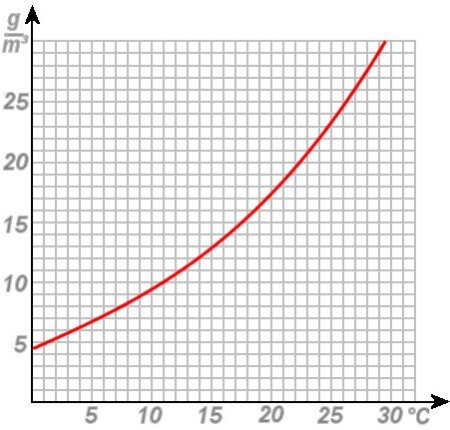
Here is the corresponding diagram. Up to about 30°C, the value of water in grams per cubic meter of air is similar to that of the temperature in degrees Celsius. The figure shows the maximum possible
amount of water that can be contained in one cubic meter of air. Just a little more, and the water will settle somewhere. The same thing happens when air cools down while at its maximum moisture content.
|