|
| 
|
 Evaporator Evaporator
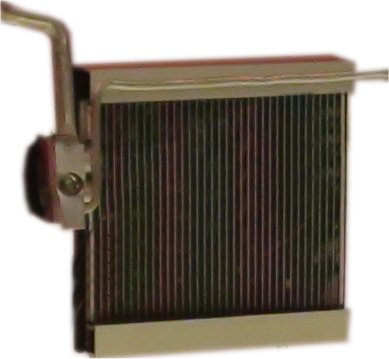
A typical feature of the evaporator are metal tubes whose surface area is increased by metal plates. These are called ‘lamellas’ which are usually made of aluminum. Although copper has nearly twice the thermal
conductivity, it would be more than three times as heavy. Unlike in a radiator, the evaporator is not a chamber filled with refrigerant through which air ducts pass.
Condensate, as already described in this book, must be able to drain away from beneath the evaporator. This condensation from the air can, of course, also turn into ice on the cooling surfaces, which hinders further heat
transfer. Therefore, the spacing between the lamellas depends on the likelihood of ice formation, which prevents a continuous ice barrier from forming.
However, in passenger cars, there are evaporators with collectors or distributors that are similar to the water tanks in a radiator. However, they are not arranged to the left and right of the pipe network, but only at the top, in
pairs one behind the other. One distributes the incoming refrigerant among the various pipes, which then guide it downward and back upward on the other side. It is then collected there again for the exit.
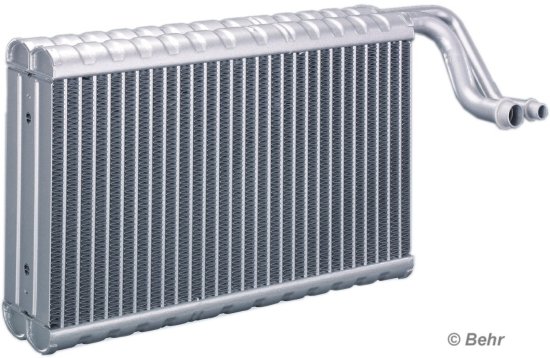
From above, the whole thing looks like two heat exchangers placed one behind the other. The laminated flat tubes are crimped in such a way that they remain in contact with the flowing air for as long as possible. Even the
vertical lamellas between the flat tubes have additional diagonal perforations. There is a clear effort to achieve a good ratio of thermal conductivity to weight.
| The evaporator and condenser must not be repaired. |
A great deal of effort goes into ensuring that an air conditioning system does not introduce unpleasant odors into the passenger compartment. In some cases, the system automatically switches to recirculation mode when
certain ingredients, detected by special sensors, are present. To prevent microorganisms from accumulating on the evaporator, it is coated with a special coating. If that does happen, it's probably not possible to clean it
right away. It's installed in too hidden a spot for that. One solution, for example, is to use sprays that are applied more or less directly to it.
|
|