|
| 
|
 User Manual 5 User Manual 5
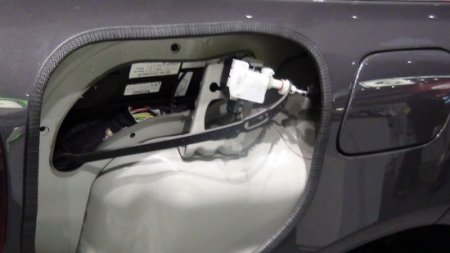
Additional Air Conditioner for the Rear
There are vehicles in which customers can even choose between a manual single-zone air conditioning system and a fully automated four-zone air conditioning system. In all cases, the basic design, and thus the air
conditioner at the front, is essentially the same. Of course, the simplest system benefits from the use of identical parts. It has the same activated-carbon filter, glove compartment cooling adjustable via a rotary knob, and air
vents on the B-pillars.
A large SUV like the Touareg has the advantage that parts can be removed individually without having to take the entire system apart. This applies, for example, to the heating system's heat exchanger. The air conditioning
system has so many similarities in the front because the optional third and fourth zones are controlled by a separate air conditioning unit located in the rear left, of course, only if this equipment option has been selected.
Of course, a separate climate control system like this also requires a control unit for the rear seats. It resembles the typical layout of a dual-zone air conditioning system, with an adjustable digital temperature display in the
upper left and right corners, respectively. Overall, it is smaller than the front one, but, like the latter, it allows for additional adjustment of air distribution and fan speed.
Naturally, the settings for the rear can also be adjusted from the front. In addition, it is possible to switch to continuous or automatically controlled recirculation mode, while maintaining activated carbon filtration. There is
even an option to let the control unit handle all air distribution. In addition, an economy setting can be selected here, as well as the previously mentioned on-demand request of residual heat.
A system designed for only two climate zones always treats the front and rear seats the same. However, only different temperatures can be selected here, while the other parameters are the same for all seats. One very
convenient feature, however, is that the warm or cool air can flow simultaneously through vents in the center console, the footwell, and the B-pillar.
Now, in the case of a four-zone system with a separate air conditioner in the rear, there are, of course, two evaporators connected in parallel, which are linked to a condenser via a compressor. In addition to the high-
pressure sensor already mentioned in this book, the refrigerant temperature in both the high- and low-pressure circuits is also measured and transmitted to the control unit. Each evaporator has its own expansion valve.
There are four air vents on each side, starting from the footwell and extending all the way up to the windshield. Each one requires a servomotor, which also needs a potentiometer for feedback. The fifth servomotor switches
back and forth between warm and cold air as needed, thereby creating the desired mixture. Of course, this requires temperature sensors to be installed behind them.
From what has been said so far, it is clear that the air conditioner in the rear left corner of the trunk also requires a dual connection for both the cooling system and the refrigerant. The former is therefore likely to expand the
cooling circuit to 10 liters and must first be heated by the engine; only with precise control will this not unnecessarily prolong the engine's cold-start phase. Will the passengers in the back, who are used to comfort, like it?
In modern German, this is called 'thermal management'. Actually, it's not even a compromise. As you might expect, comfort wins out over economy. As soon as the coolant reaches 20°C, there's little point in doing this
before then anyway, it helps transport the engine's heat. After all, the fluid isn't being recirculated in the engine beforehand either. Of course, it would be better for the engine if it stayed that way up to about 80°C, but as I
said, comfort takes its toll.
After all, the number of additional vents at the rear is limited to three per side, and, combined with the temperature control system, eight servomotors are sufficient. The front control panel is connected to the rear control
panel via CAN bus. Although this system does not use a master/slave configuration, it can still be used to ensure that the settings at the front also are obligatory to the rear (rear button).
Of course, you can now also control these features using the large touchscreen. Maybe the control unit will be eliminated entirely in the next generation. That way, developers won't have to come up with a new hardware
layout every time. If there is enough space, the graphic will also be more self-explanatory and appealing. In some cases, you can now use words again instead of symbols, because the software can translate the terms into
different languages.
In addition to the CAN bus, the LIN bus is also used in air conditioning systems. Since it does not significantly increase the cost of the sensors, it transmits data from the humidity, air quality, and pressure sensors to the
control unit. Incidentally, the former is mounted above the rearview mirror. In simple terms, it works like a capacitor, where the moisture coming from the windshield changes its capacity. High humidity means greater
cooling, followed by a corresponding warming of the air.
|
|