Performance Only on Paper?
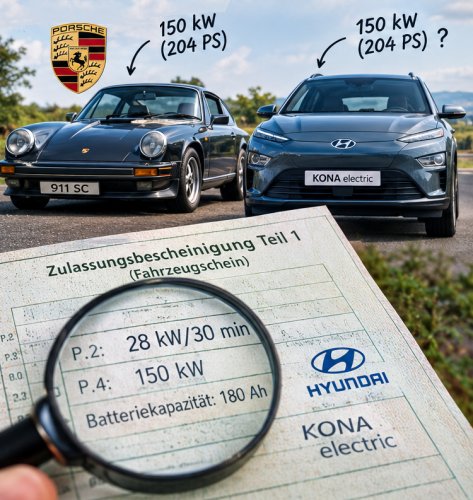
As we've mentioned many times before, we drive a Hyundai Kona Electric that, while still relatively new, is already getting a bit old. From time to time, we take great pleasure in writing about classic Porsches. Now
you're probably wondering what all this has to do with each other.
In the Porsche lineup, we once reached the 911 SC. It was introduced in the 1978 model year and replaced the 911 and Carrera models. Its power output increased from 132 kW (180 PS) to 150 kW during the
years 1981–1923.
And that's when we first got suspicious, because, strangely enough, our electric car is listed as having the same power rating. What if we were driving a Porsche and had actually paid only a fraction of the price for it?
Does an electric motor produce a different number of kW (PS) than a three-liter internal combustion engine? We can't really judge, we've (unfortunately) never driven a car like that, but we're already more than satisfied with
the performance of our Kona.
If you think we should calm down, we're afraid we'll have to disappoint you. We're just starting to get upset. Because when we look through the Certificate of Registration, Part 1, we find:
P.2.:28 kW/30 min, 150 kW rated power * battery capacity 180 Ah*.
So which is it, does it have 150 or just 28 kW, and even that only for 30 minutes? So that's supposed to be the electric system's peak 30-minute output, allegedly a legally defined metric, either very precise or just as
useless.
In other words, the Kona under test, when run at full load for half an hour, reached only 28 kW, or about 38 HP. That can't be right, because in the same Part 1, the top speed is listed as 167 km/h, which is impossible with
28 kW.
Or is the maximum speed simply not guaranteed for a period of 30 minutes? But that would be a huge step backward. We, on the other hand, are certain that for at least half an hour, we drove at speeds that required more
than 28 kW.
So it's simply impossible to understand the purpose of this performance specification. But this is even more true at the specified 150 kW (204 HP). In the past, people used to bring up to top speed their car at least once in
its lifetime. Then you'd know roughly what speed the car had to reach.
That is no longer possible nowadays due to speed limiting. And while the completely impractical 28 kW at least specifies the duration of power delivery, this is not the case with the so-called peak power.
We're starting to suspect that there's an excessive amount of lobbying going on. In the very early days, manufacturers had to dig deep into their pockets to cover the costs of the various performance classes of their models
due to the enormous effort involved in engine construction.
The turbocharger made it possible to produce engines with different power outputs by adjusting the boost pressure. Today, this can be solved with software, and no one can really verify whether the more powerful, and
therefore more expensive, engine remains unchanged.
It would then simply reach the temperature needed to reduce power more quickly. And no one notices. The acceleration could be a little better, but it wouldn't be able to maintain as many peak accelerations.
Now you know why some testers seem to perform several accelerations in a row, which may seem completely nonsensical. But that still doesn't allow for a comparison between different models because many factors play
a role in acceleration.
|