Toyota hybrids
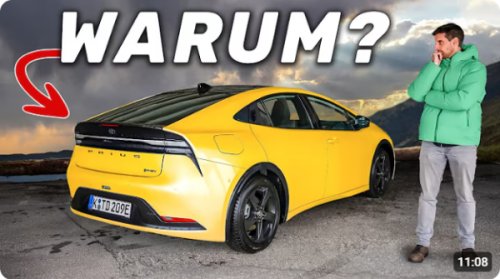
kfz-tech.de/YKfz11
How skilled are the Japanese at Toyota? We can tell you: 'Very clever.' Whether this will remain the case or whether they will still manage to make the transition to genuine electric mobility remains to be seen, however.
But so far, they have done a very good job, from their point of view.
No, we don't want to tell the whole story again, probably starting with the Prius I. The only thing it has in common with the brand's latest creations is the name. We are also explicitly staying with the hybrid version without a
plug-in.
Because it also shows, if you'll forgive us, a certain cunning. The idea for this chapter came to us while collecting data for what is currently the latest Corolla version, a car with an impressive 70 kW of electric power and a
battery capacity of just one kWh.
And it's even advertised as a lithium-ion battery. As if that wouldn't matter with so little power. Incidentally, you have to search hard to find the battery capacity at Japanese hybrid manufacturers. For good reason, because it
is so small.
This essentially means enormous cost savings, and yet the car can still be marketed as a kind of electric car. Terms such as "bridge technology," "full hybrid," and "self-charging" are popping up, not even from Toyota itself,
but from eager YouTubers.
We'll get to that part of the YouTubers later. To understand what the manufacturer can actually do with such a small battery, we need to look at the disadvantages of the combustion engine. Because that is exactly what
Toyota's engineers have apparently done.
Let's start with intersections, or more specifically, traffic lights. They now represent all situations in which the gasoline engine is running but the car is not moving. They waste energy unnecessarily, which an electric drive
saves.
A Toyota combustion engine does not need to be started; it starts up electrically and gently engages at some point. Even the first task seems tailor-made for Japanese engineers, whom we
credit with the ability to tinker with something until it works perfectly.
Now take a look at any acceleration process. Some people, even experts, still haven't understood that responsibility for this changes from the lambda sensor to the air mass meter, but only then.
Why is that? Because when you press the accelerator pedal, more air is supplied to the engine until the lambda sensor realizes that it needs to be enriched. In addition, additional fuel must be injected, and the air mass
sensor is designed precisely to solve these problems.
Presumably, the Toyota combustion engine has been weaned off enrichment, leaving acceleration to the electric motor. But does that explain why the electric motor has to be so powerful? In terms of cost, it is naturally less
significant than a larger battery, as it does not require complex cooling for such short periods of use.
You mean that's all there was? Then you have not considered one of the biggest flaws of the combustion engine, namely its inability to recover kinetic energy during any deceleration. Only the electric component in the
vehicle can do that.
Once again, the accuracy of recording the interactions is of utmost importance. It's simply not enough to keep making the battery smaller and smaller. This is because it must be ready to absorb the energy and must not, for
example, be fully charged for a long period of time.
Nevertheless, you always need enough energy for boosting, i.e., helping the combustion engine to accelerate. This is precisely where Toyota's long-standing experience lies, which the company is unlikely to abandon, and
the world doesn't seem to want that either, as the sales figures show.
Now, back to the problematic YouTubers. They don't mention that fuel consumption on the highway hardly changes, because even the most impressive hybrid drive is powerless when driving at a steady speed.
One can only hope that Toyota drivers will adapt to the Japanese speed limit of just over 100 km/h on the highway. No, such YouTubers proudly point out the lower fuel consumption in the city, as if this were the lion's share
of a 4.65-meter-long Sport Tourer.
And where do these impressive WLTP figures come from? Of course, in this case, not from a battery that is not counted, as is the case with plug-ins. But take a closer look at the WLTP curves. They go up and down and
have service life, as if made for a hybrid car.
But if we describe the company's actions as 'sly', then what has been said so far is not enough. Then we need to take a closer look at the combustion engine. While the aforementioned YouTubers
talk about a 'new' engine, we would rather describe it as 'older'.
You rub your eyes in amazement, because there's something about suction pipe injection again. The direct route of fuel into the combustion chamber, with its higher costs, has been avoided, meaning that the engine has
become less efficient.
The direct route of fuel into the combustion chamber, with its higher costs, has been avoided, meaning that the engine has become less efficient.
There is also no longer any mention of the once widely advertised VVT-i or VVT-iE engine control system, whether for the intake side only or 'dual'. Could it be that the development towards a more efficient hybrid has led to
a more old-fashioned combustion engine?
Recently, the trend toward summarization has even continued.:
| Energy consumption in l/100km |
| Combined | 4,4-4,8 |
| Downtown (low) | 3,6-4,1 |
| Suburbs (medium) | 3,4-3,8 |
| Highway (high) | 3,9-4,2 |
| Highway (maximum speed) | 5,7-6,1 |
| CO2 combined | 100-108 g/km |
This is so cleverly listed with the separation of 'city center' and 'suburbs' and the 'combined' CO2 consumption that you don't even notice the normal combustion engine consumption on the highway. Take a
look at which YouTubers are pointing this out.
The focus seems to be a little too much on costs and a little less on the fight against climate change. And the world happily joins in. Especially in conservative America, the concept seems to be catching on easily. Only the
'stupid' Germans seem to be torpedoing it.
But even these can be captured by offering a more than healthy discount now, even before the federal government has made a statement. But that's cleverness, not craftiness. If the others are so slow, then the Japanese
deserve credit for it . . . .
|