Those were the days . . .
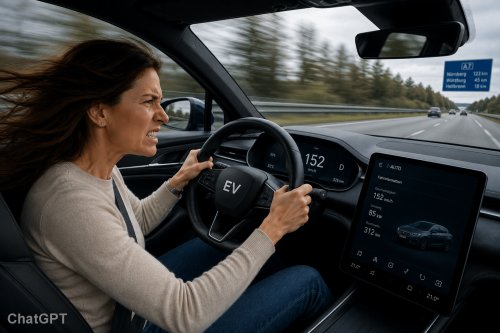
Recently, due to an urgent appointment, I drove at a good 150 km/h all the way. I used to do that for fun earlier in my diesel Golf, too. Nowadays, I can afford to do it because I’m currently driving on solar power.
But when I compare the two vehicles, there's quite a difference in noise level. Compared to our Kona E, the D-Golf was downright quiet. Why? It's the tires. They're not only uncomfortable, but also loud (picture above).
And it's not even consistent, because the road surface on the highway changes relatively often, especially when you're driving at 150. I didn't pay much attention to that in the past. That said, I keep my tire pressure as low as
possible, if only for comfort.
How lucky that 150 km/h is too fast for me anyway. 110 to 120 km/h is much more enjoyable. But what made the Golf so appealing was that, even at that speed, it still consumed just over 5 liters/100 km. Today, I'm just
happy to be able to pass the trucks.
Yes, driving an electric car is somehow different; people around you tend to find it a little eerie. In the past, everyone could hear whether it was a successful or rather futile attempt to get started. It was all too clear
the sound of an engine that was just barely rumbling.
Even back in the days of gasoline injection, you could tell in an instant, by turning on the ignition and diverting the fuel into a container, whether any fuel was actually reaching the engine compartment. Sniffing the exhaust
revealed within seconds that the mixture was too srich.
You would often get a mild electric shock from the ignition, but then it seemed to work. What a great way to learn something about the innermost workings of the engine just by removing even a single spark plug. And where
else will we be able to measure compression in the future?
Back in the day, tow trucks actually lived up to their name. But in principle, anyone could have towed a car. Sometimes circling the block several times, until the hope of hearing the engine run steadily had finally died.
Nowadays, you can’t even bump-start it anymore.
Or a rescue from a shallow river or lake. First came the bumper, then maybe a piece of the front trim, and only then the entire car. Back then, you could still change tires yourself, but today, you can't really do that at a repair
shop without having completed Part 1 of the electrical training course.
Towed someone even though I was already running on reserve. He's bringing a spare canister. But towing uses so much gas that you'll inevitably have to unhook the trailer and find a gas station. Then he
suddenly pulls out another spare canister . . .
Try applying this story to two electric cars. Everything has become so sterile, and not just traffic. Where has idling gone? At some point, they'll even do away with the horn.
Because cars were so expensive in the Netherlands, I bought two Polos and an Audi 50, one to serve as a source of spare parts for the other. I built a trailer out of a rear axle, bolted the towing vehicle's license plate onto it
and just like that, many transportation problems were solved.
These days, you're not even allowed to drive with the tailgate open. There are three ISOFIX anchors on the back seat, and only there, but then the child seats don't fit side by side. There's a nice German term for this:
'Verschlimmbesserung' (bad improvement).
| Just when car emissions are being phased out, you're no longer allowed to drive with the trunk open.
|
|