Automotive Technology - American Trucks
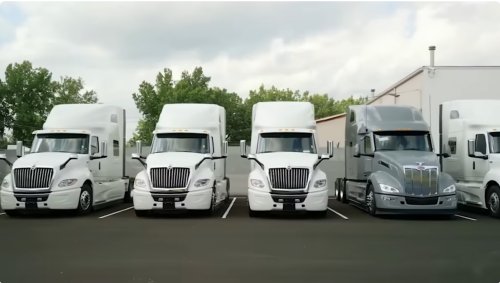
. . . but the pictures are beautiful
At first glance, you might think they're heavier and bigger than their European counterparts. Longer, yes, because U.S. authorities only specify the length of the trailer. However, this makes them more modern than one might
expect.
After all, as part of the shift toward electrification, European trucks are also being given a slightly longer front end to make them more aerodynamic and thus more efficient. Looking toward the electric future, there also
seems to be a trend toward three-axle tractor-trailers, just as in the United States.
Yes, they do get a lot heavier with batteries. In fact, American trucks have been moving closer to European ones for decades now. This may also be due to the fact that the company has been acquired multiple times by
European firms.
The oversized American diesel engines have been replaced by the European standard of six cylinders and 12 liters of displacement, with some models even reaching up to 16 liters. The extremely complex American
manual transmissions have almost disappeared.
It is only with the brakes that there still seem to be differences. This is all the more surprising given that speeds there are significantly higher. This refers to actual speeds, which in Europe are probably no more than 90
km/h, but in the U.S. exceed 113 km/h (70 mph).
No, you can't say that all American trucks are equipped only with drum brakes, but they still seem to be the norm. And, of course, those are not exactly the most suitable means of braking, especially at higher speeds.
The testing cycles also appear to vary, for example, they last half a year in Germany and an average of one year in the U.S. Here, it's normal to simulate a loaded truck as well, but in America, that's apparently not always the
case.
The electronics are also lagging behind a bit. While the development of European trucks is already moving toward EBS and electronic control systems, it seems that in the United States, manufacturers are content to settle
for the introduction of ABS. However, the safety systems for the braking system are identical.
Setting aside the number of axles, there does not appear to be a significant difference in weight between an American and a European truck of comparable length. You can tell by the, in some cases, extremely flimsy fairing
on the extended front end.
At the same time, American truck drivers are beginning to appreciate the visibility offered by cab-over-engines. And when they realize that even the noise levels of their more distant electric motors are reduced, they are
absolutely thrilled.
So it seems Tesla got a lot right from the start with its Semi truck and its aerodynamic nose. Disc brakes are installed there in connection with energy recovery, which is even more important in trucks.
However, what is deterring local truck operators from choosing this vehicle is the lack of a bed. And right now, the company seems to be shying away from development costs. They have obviously managed to
obtain European homologation with minimal changes.s
|