|
| 
|
 Self-supporting Self-supporting
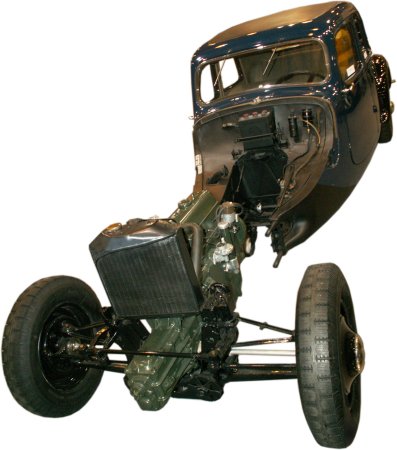
These are the front axle, including the drive, and the self-supporting body of the 1934 Citroën Traction Avant, reinforced with sturdy side skirts, not unlike a frame. The two parts are connected
by only four bolts. Today, we know of no other design for passenger cars. It is even common in convertibles without a reinforced roof. At that time, that was by no means the case.
Although the construction of the car was officially initiated by André Citroën, but not assigned to those officially responsible for new developments, but rather delegated to aircraft engineer André
Lefebvre. The
situation was critical for Citroën, and the car had to be finished in record time, including numerous teething problems.
The self-supporting body is, so to speak, the crowning glory of automotive design, which had already been ongoing for about 10 years at that time. Of course, this does not mean that there were
no
wood-core structures during this period and afterwards; on the contrary, they still make up the majority. The number of metal bodies without any wood had something to do with series size, and
by Black Friday 1939, the number of companies manufacturing chassis, bodies, and/or entire cars in Germany had grown to an estimated 100.
Only large companies such as Opel could afford the new sheet metal presses for large body parts or ordered the bodies to be manufactured by Budd Corporation in Berlin. Interestingly, BMW
also belonged to the latter group with the significantly modified Austin Seven (Dixi). At this point, at the latest, it is important to make a clear distinction between bodies made entirely of steel and
self-supporting bodies.
The former was achieved when load-bearing parts are completely free of materials such as wood, the latter when the structure was so stable that the frame underneath can be dispensed with.
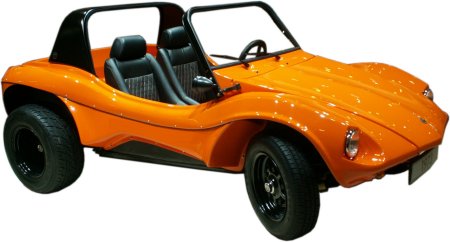
So much for the pure doctrine, but there are many mix forms. For example, the floor assembly of the VW Beetle was so sturdy that it could be shortened and fitted with an open plastic body to
create a (dune) buggy (picture above).
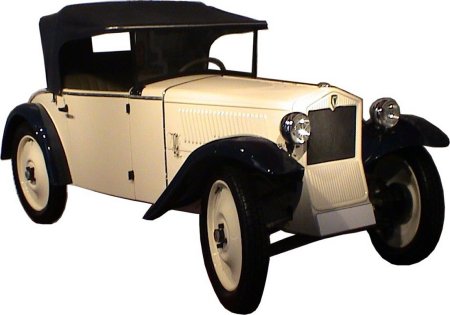
Conversely, a Beetle convertible still needed reinforcements on the otherwise identical chassis. The first DKW front-wheel drive car from 1931 (picture above) even had plywood reinforced with
sheet steel frames. In the chapter 'Fender struts', you will learn how even these can reinforce a car body. But then it's also and especially about safety in the event of a crash. In the 1930s and
before, this was not an issue.
The Budd Company is famous for introducing presses in 1915 that could produce increasingly larger surfaces for car bodies from sheet metal, which is now mostly rolled. At first, these may have
been only
small metal sheets and fenders, for example, but soon there was strong growth in this area. But that stagnated at some point in the middle of the century at about the size of a car roof,
only to pick up again towards the end, for example, with side panels for the luxury class in one piece.
That's about how long it took for the steps in between to be automated. For the large presses stood in rows, whereby laymen sometimes saw no progress at all with the metal sheets. But it was
no use; sheet metal apparently needs these procedures to prevent it from warping unfavorably when exposed to increased sunlight. So for decades, it still had to be placed by hand from one
press to another.
The problem that there cannot be such a sheet metal line for every type of sheet metal required has not been definitively solved. So for decades, the mold also had to be changed once a certain inventory level was reached.
This procedure is indeed late, but it has now been automated. Let's note that it took a long time for sheet metal pressing to become widespread and even longer for it to become fully automated.
Of course, even the most beautiful sheet metal parts are useless if you can't connect them. From the development perspective, such a connection can be made using screws and, more cheaply, using rivets. The latter
method did not last long, whereas screws remain important to this day for all parts that may need to be replaced more frequently, e.g., front fenders.
A little deeper into the body shell, spot welding is still very common today, although it is supplemented by even more modern processes such as laser welding.A little deeper into the body shell, spot welding is still very
common today, although it is supplemented by even more modern processes such as laser welding. In the early days, manufacturing plants often used oxyacetylene welding equipment, which was invented shortly after the
turn of the century but only became widely used during the era of large-scale production. With the 1920s, as discussed in this chapter, steel began to replace wood in construction, and gas welding was also already in use.
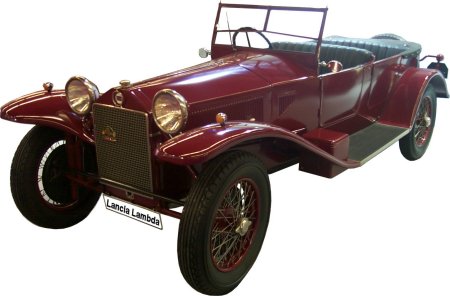
This image brings us back to the theme of the self-supporting body. This 1923 Lancia Lambda is probably the very first representative of its kind, even though it is a four-seater convertible. The long side walls, although
weakened by upper door openings, were pressed in one piece, which was only just possible at Budd at that time. Underneath the car, only a center tunnel provides additional stability.
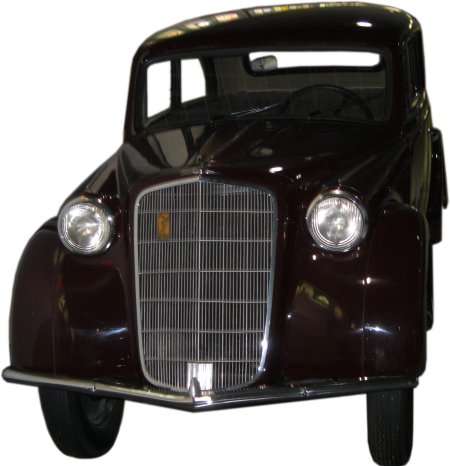
This is the Opel Olympia, which was released for the 1936 Olympics and named after them. The date shows how long the self-supporting body took to achieve even partial success. The chapter cannot end without
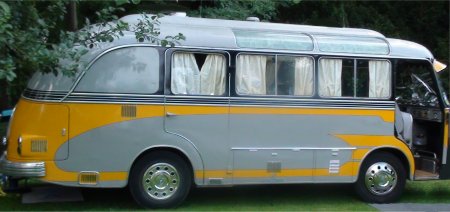
mentioning Kässbohrer and its self-supporting bus bodies. The S6 shown below, dating from 1955, could be carried by six workers.
To make it clear that the process towards a self-supporting body was by no means irreversible: For decades, American road cruisers still had a frame because it made the annual cosmetic work easier. Citroën, one of the
'inventors', also stuck with the frame construction in its CX model, for example, until 1991.
|
|