Design 2
kfz-tech.de/PKa60
Is it really still the case that form follows function, that overall design determines market success? The fact that the spirit of the times plays a significant role is also evident in automotive design. Here, the tension is
often noticeable, as the design of a car body must be both modern and, at the same time, rooted in a manufacturer’s history or tradition.
Even when you compare a car magazine from today with one from the past, the difference in focus is striking. It used to be based on the technology underlying the car, whereas today it is based much more on the
exterior design. This is true, at least in part, even for experts; however, it is somewhat limited when a certain degree of loyalty to a particular manufacturer clouds their judgment.
No, there's less interest in the technology. It has clearly become less important, even though, for example, Audi's attempt with the A2 to completely enclose the engine compartment and provide only a service hatch,
ended in failure. Humans are finding themselves in an increasingly complex environment. Being able to access knowledge at the touch of a key, as Bill Gates once formulated it, is, after all, also associated with the
possibility of confusion.
This reminds me of the child who starts crying because there are so many options and he or she has to choose just one of the many gifts. It's just easier to simply look at a car, or better yet, touch it and sit inside it
and and sit inside it and form an opinion while surrounded by that comfortable atmosphere. After all, we're used to judging people in a fraction of a second.
Passing judgment builds self-confidence, even — and especially — when it is based on little expertise. In general, one gets the impression that the average modern person spends a large part of his
creative energy trying to prevent himself from getting lost in the crowd. One means of getting there is the car, which surrounds him or her like a coat or a rolling home.
The fervent pursuit of personal mobility by former developing countries, such as China, demonstrates that automobiles are indispensable as a means of spontaneous mobility and self-expression. Those who can
afford it financially go for it, sometimes, as in China, with the help of the whole family. It would be as if you were missing out on something crucial in life if you hadn't made this dream come true.
If you have a little more to invest when buying a car, design plays an even more decisive role. And since there are now many mass-market vendors offering products with similar technology, appearance almost plays
the leading role. Just think about the challenges these manufacturers face in introducing something new within an existing product line at ever-shorter intervals.
Humans began as hunters and gatherers, but they are now a long way from that, not in their genes, but in their way of thinking. The car as an extension of the self, as a representation of a living space that one eventually
wants to make one's own. Often, the step taken goes too far, and the optimism has been excessive. This leaves a regrettable disconnect between reality and the success of car salespeople.

kfz-tech.de/PKa61
As mentioned earlier, the work is done in teams. Unless it happens to be one of the rarer new developments, it is important to take into account at an early stage the needs of developers responsible for other areas.
Although, of course, sometimes it's also true that life punishes those who come last.
Woe betide us if contrary developments have already progressed quite far. Shortly before a Polo model was set to go into production, Ferdinand Piëch decided to equip it with even more lateral reinforcements. As
important as the NCAP test results may be, a delayed start to mass production is sure to cost millions.
Of course, a disagreement usually doesn't lead to a solution, no matter how early it's addressed. This calls for rules that go far beyond the specific developments in question. You can use these as a guide. It is
nonetheless astonishing how, even within the often restrictive framework of such rules, so many variations emerge, some of which, even the more daring ones, have recently begun to gain acceptance.
The life of a designer is characterized by a strange duality: the largely solitary process of generating ideas, and the process of explaining and defending those ideas to the team. Only when combined do these two
lead to self-realization. But even more admirable are the people who have to guide teams of designers through periods of excessive demands and despair.
Development should be closely integrated with production. Of course, salespeople and the sales department also play an important role. And, strangely enough, the design doesn't fit into this phalanx at the same
level, but rather relates to all of these areas. Design is everything. If it doesn't work, it's all for nothing.
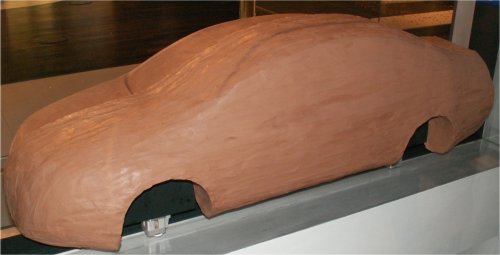
Who hasn't felt a sense of triumph, or quite a bit of disappointment, when their ideas were put into practice? For the designer, the process begins with a three-dimensional model that initially represents the exterior
at a scale of 1:5 and the interior at a scale of 1:1. One important influencing factor has not yet been mentioned: the legislature, or, more precisely, the various legislatures in different regions of the world. For once, it
is not the U.S. but Europe that is currently leading the way when it comes to rules regarding collisions with pedestrians.
It's surprising that, at the moment (2014), there's actually even more going on in interior design. This is related to the increasing number of displays. Sometimes unrealistic requests are made of the staff. Once
again, there are two related fields within design: ergonomics and haptics. In addition, the dashboard of the lower-priced model should not look too similar to that of the higher-priced model, but it should also not
be too different to operate.
Enough with the planning, let's start creating models. In the past, they were made of wood and were also used in manufacturing. You could adjust the sheet metal so that it would actually form a car body with
reasonable gaps. Of course, when items were made by hand, some rework was necessary, for example, if a door had to be replaced.
The mold is coming out of the machine today. With just a few additional data points, the 1:5 mold can also be machine-manufactured. If a project is given another chance, the much more expensive 1:1 model is built.
In this case, it probably requires rather manual labor. It can even be painted with plastic wrap and rolled outside on a special dolly. Sunlight and design must absolutely go well together.
kfz-tech.de/YKa35
|