|
| 
|
 Planets 1 Planets 1
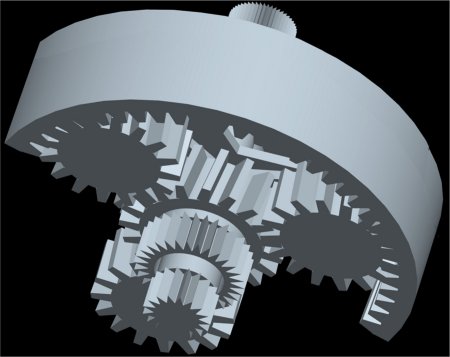
Yes, there are also planets in the automotive sector, although, as shown in the picture above, they are arranged rotating on shafts. However, these waves can also rotate in space, albeit only in conjunction with the rotation.
This type of interlocking connections may have inspired the association with the outer space.
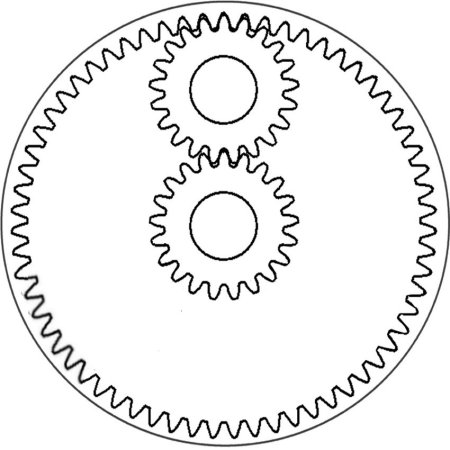
To make it easier to understand, only a single planetary gear remains here. It would work, of course, because all planetary gears essentially do the same thing, but in practice there are three to six of them, all designed to
transmit lots of torque. It is probably still correct to say that every automatic transmission designed according to the classical design contains planetary gears or, more accurately, sets of planetary gears.
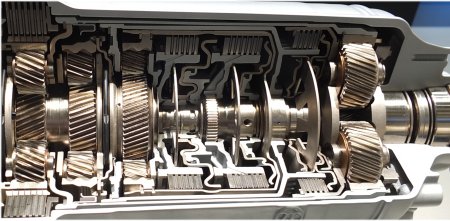
Here they are clearly visible: four sets of planetary gears, helical-toothed, with three on the far left and four on the right. That probably depends mainly on the torque to be transmitted, namely how many planetary gears
are incorporated into the design. On the left, the input torque is lower; on the right, the output torque is higher. You only take as little as necessary to conserve efficiency. You can also see cut-open clutches in this case.
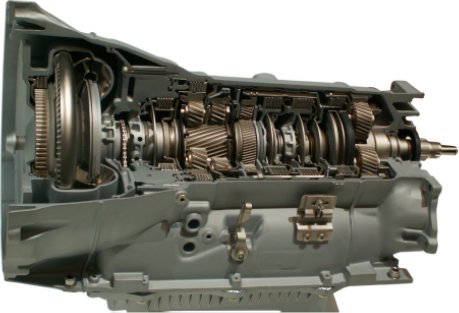
If you omit the converter or the clutch that might replace it at the top-left input, then such an automatic transmission consists, in principle, only of planetary gear sets and clutches. Of course, we mustn't forget the control
system, which is now partly hydraulic and partly electronic; here, it is housed in an eight-speed transmission beneath the axle, along with the planetary gear sets and clutches.
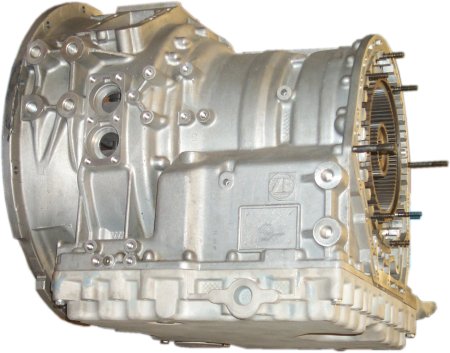
This somewhat older automatic transmission for a city bus clearly illustrates the two-part design and thus the basic structure of an automatic transmission. While in a standard manual transmission, at least two shafts are
usually arranged side by side or one above the other, forming a figure '8', in an automatic transmission everything is grouped around a single shaft. This would result in a circular shape, if it weren't supplemented by the
control box.
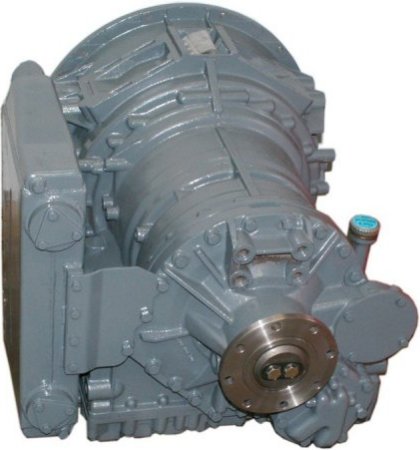
An oil-coolant heat exchanger has been added here, which, on the one hand, makes it a bit harder to easily identify automatic transmissions, but on the other hand serves as a helpful reminder that an automatic
transmission can generate much more heat than a manual transmission. But more on that when we get to the topic of 'torque converters'.
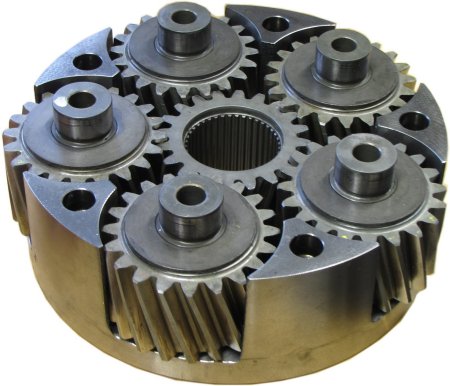
Let’s return to our main topic, which offers a striking contrast to the image at the beginning of this chapter. The space here is used really well, which also highlights just how compact the planetary gear sets are. The only
thing missing now is the so-called ring gear with internal teeth. We will show that this can already be used to create a two-speed transmission with a reverse gear, though with gear ratios that are not entirely independent of
one another.
When we connect the planetary gears using a so-called ‘planetary gear carrier,’ we are dealing with three parts: the sun gear in the center, the planetary gear carrier, and the ring gear on the outside. Unlike a conventional
gear drive, we cannot simply connect one part to the input shaft and the other to the output shaft; instead, in order to transmit torque, we must hold the remaining part in place.
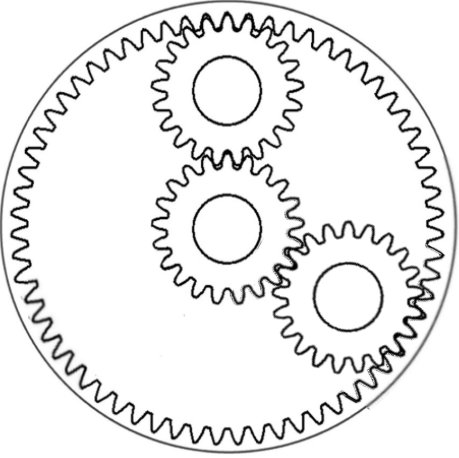
No, this isn't a second planetary gear that's been added; rather, the idea is to simulate a full counterclockwise rotation of the planetary gear while the ring gear is held in place. Since it has 21 teeth, it covers exactly one-third
of a revolution on the 63-tooth ring gear. That would also mean a one-third turn for the planetary carrier connected to the output shaft. The interesting question: What about the sun wheel?
This is, of course, connected to the engine or the crankshaft. In our example, it has the same number of teeth as the planetary gear. That's easier to calculate. This works in practice, too, but one does not prefer a 1:1 ratio
there, because the same tooth always ends up in the same gap. Consequently, even minor wear and tear is not compensated for.
Anyway, we just want to understand the principle. If you look at the picture again, you'll notice two drives for the sun wheel. It must make a full revolution at the same time, because it meshes with the planetary gear, and an
additional third of a revolution because the planetary gear's position has changed. That comes to a total of 1 1/3 rotations. That’s enough to fit four full revolutions of the planetary carrier: a 4:1 gear ratio, not bad for a first
gear.
During a brief pause, we hold the planetary carrier in place and transfer the downforce to the ring gear. You can probably guess, that’s the reverse gear. In this case, the planetary gears act merely as intermediate gears
and are not included in the gear ratio. Result: With three times as many teeth of the ring gear, we now get a gear ratio of 3:1, not ideal, but just about acceptable for a reverse gear.
There is always one gear in an automatic transmission: the first gear. In addition, there is the connection between the sun gear and the engine. In addition, the planetary carrier and the ring gear are coupled together,
regardless of which one is connected to the downforce. At a 1:1 ratio, that would be the highest gear. In theory, one could lock the sun gear in place and connect the planet carrier to the input shaft and the ring gear to the
output shaft, which would result in a three-speed transmission with a reverse gear.
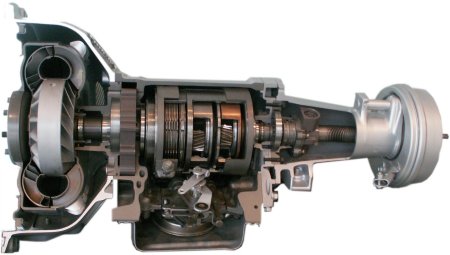
We don't do that because it would require too many clutches and complicate the whole thing. Above you can see one of the very first automatic transmissions ever made, called the 'Power-Flite', manufactured by Chrysler in
1953. It has at least two planetary gear sets, which can be considered the minimum requirement for automotive automatic transmissions. Here, the balance between the need for clutches and the need for gears is the
most optimal.
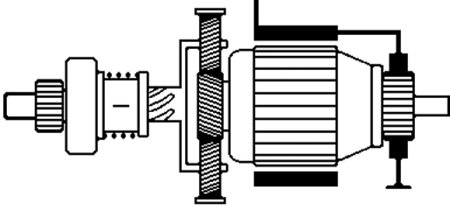
| Planetary gears are also found in applications that do not use clutches, such as in starters. |
|
|