Multiple disk clutch Multiple disk clutch
kfz-tech.de/PGt39
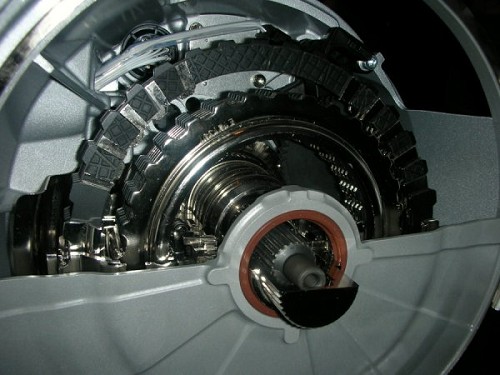
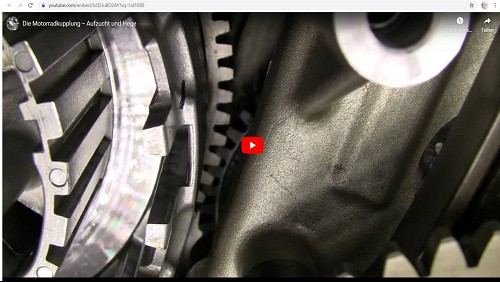
This chapter is deliberately not devoted solely to two-wheeled vehicles. If you would like more detailed information than is provided here, please refer to the video at the end of this chapter. But, even though this
isn't just
about the motorcycle, let's start with some basics about how the transmission and clutch work together here, since the clutch plays a different role on a motorcycle than it does in a car.
It is important to note that manual transmissions do not have synchronizers. This is another reason why shifting gears without using the clutch is possible in the first place. If it were synchronized,
this would put an enormous strain on it, because it would try to achieve synchronization, which it cannot do without the clutch disengaged, and its friction surfaces would suffer as a result.
No, as the name suggests, these are sturdy claws used to connect toothed gears to shafts. You can also feel exactly when the gear is engaged or not via the foot-operated gearshift. So if you apply gentle
pressure, the corresponding claws snap into the nearest available slots, especially since these are sometimes significantly larger than necessary.
Of course, the engine really shouldn't be running at full throttle at this vulnerable moment. So you briefly ease off the throttle. Those are shift times then drivers of manual transmission vehicles can only dream
of. They go perfectly with a motorcycle’s incredibly high acceleration figures, of course. But please, don't force the gearshift lever.
There is also what's known as a quickshifter. First of all, it's just a sensor that detects when the foot pedal is pressed. It doesn't disengage the clutch either, but it definitely cuts off the fuel injection and
possibly the ignition for a moment. After that, he lets the cylinders start up again one by one, which is perhaps a bit gentler than giving the throttle full force again.
So do we even need the clutch anymore? Definitely for starting off. But before we take a closer look at that, let’s first talk about the clutch in a Golf 2. Why? Although it isn't a lamella or multi-disc clutch, it
works on a very similar principle as a motorcycle clutch.
kfz-tech.de/PGt40
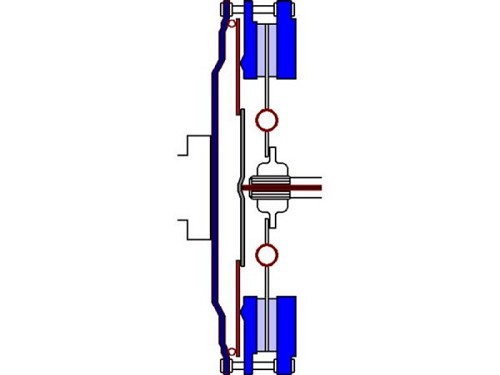
No, you wouldn't immediately think that something like that would be built into a car, especially one produced on such a massive scale. We'll get to the “why” later. At
first glance, the flywheel and pressure plate appear to be interchanged. Assume the crankshaft on the left, to which the latter is bolted. The disc spring is very important; it can be deformed towards the
crankshaft by a round plate in the center.
This is triggered by a rod that passes through the gearbox's input shaft. If this is pushed to the left, the pressure plate moves slightly further and the clutch disc moves slightly less, also to the left. The disc is
free and the clutch is disengaged. The more compact design of this clutch was likely intended to create space, for example, for larger engines or perhaps an additional electric drive. Side note: The thrust
bearing was mounted on the outside and could be replaced without having to remove the clutch.
kfz-tech.de/PGt41
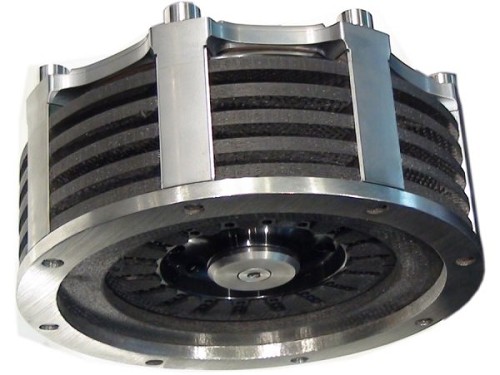
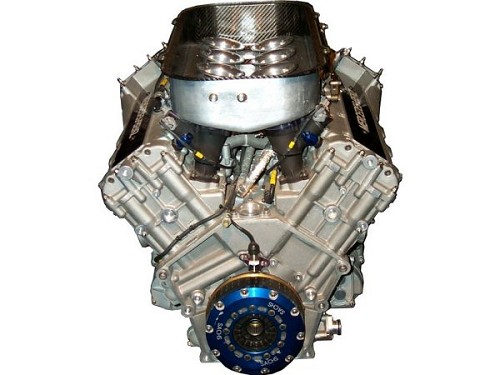
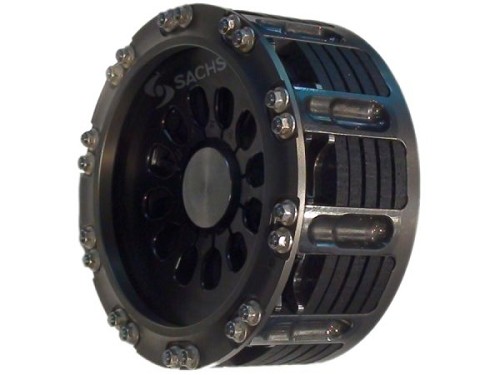
Now let’s talk about the multi-plate clutch, but still not the motorcycle. The one at the top is for the DTM, and the one at the bottom is for Formula 1. This is where carbon discs come into play; they can
withstand an incredible amount of heat and are also very lightweight. Another advantage of such clutches in racing is that their small diameter allows for a lower center of gravity for the engine, which doesn't
have an oil pan anyway due to dry-sump lubrication.
kfz-tech.de/PGt42
kfz-tech.de/PGt43
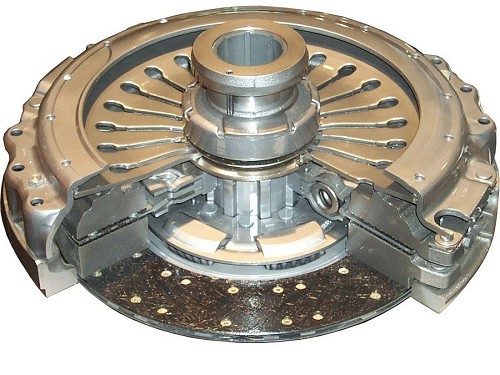
No, we still haven't gotten to the motorcycle. First, we need to mention the truck. In this case, a single-plate clutch would be too large due to the torque that needs to be transmitted. Take a look at these
dimensions. By the way, these clutches are dry, meaning they operate without oil. This is different with most multi-disc clutches.
kfz-tech.de/PGt44
kfz-tech.de/PGt45
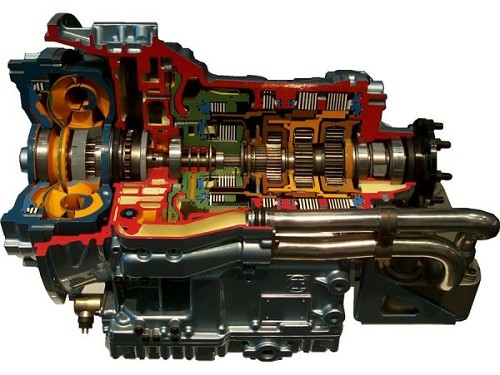
Automatic transmissions, more accurately described as torque converter-type automatics, even though they don’t always have a torque converter these days, are packed with multi-plate clutches. Here, oil
pressure causes certain combinations within or between planetary gear sets to be disengaged and others to be engaged. Whether it is a transmission for a passenger car or a truck (as shown above) is of
secondary importance.
kfz-tech.de/PGt46
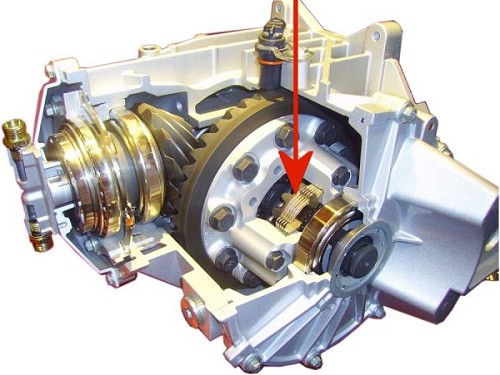
Lamellar clutches are currently very popular in the all-wheel-drive sector. This involves engaging, for example, the rear axle as a whole or individual wheels, as shown above. Another common approach here is
to use a purely electric actuator and/or partial torque transfer. You could also call this 'letting the clutch slip', which vehicles with a wet clutch seem to handle just fine.
kfz-tech.de/PGt47
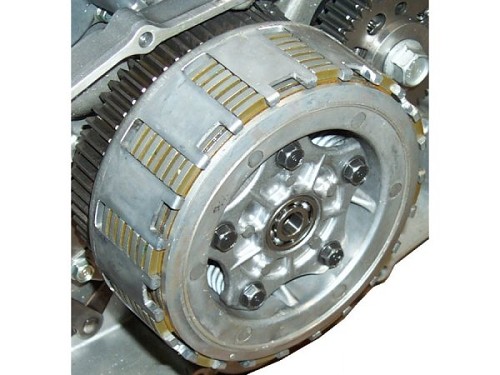
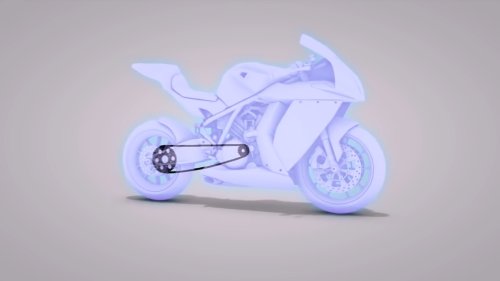
Now, finally, we're talking about a motorcycle's clutch. By the way, just as not all motorcycles have a shifting claw transmission, they don't need the corresponding multi-plate clutch either. For example, a
BMW boxer engine uses a rear-wheel drive system that is more similar to that of a car. In the upper right corner, you can still see the drive gear connected to the crankshaft. However, the larger gear is
mounted on the input shaft of the transmission.
kfz-tech.de/PGt48
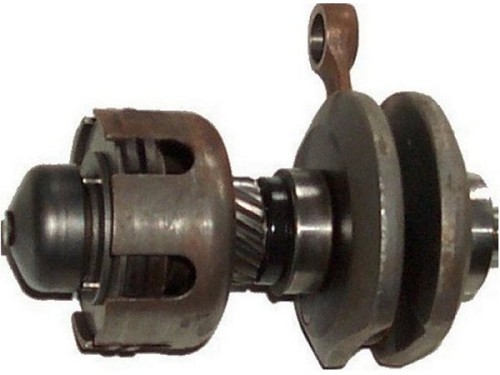
There is another way, as this picture of an old moped clutch shows. But inside this pot, there is always a steel disc and a disc with a high-friction coating. It is important to note that each group is equipped
with either an internal or external positive-lock connection.
kfz-tech.de/PGt49
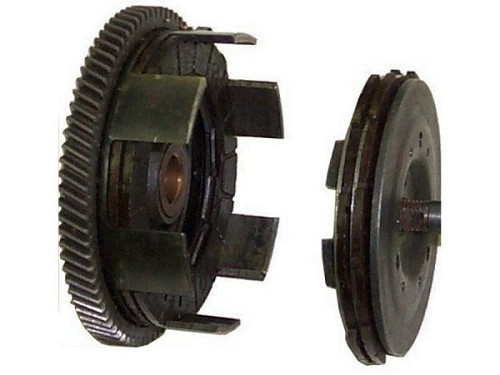
Here is an older clutch that has been dismantled. So whatever rotates with the motor is the large gear that reduces the motor's speed and correspondingly increases the torque. But only
when the clutch is engaged does the input shaft of the transmission, on which the entire assembly is mounted, begin to rotate as well.
kfz-tech.de/PGt50
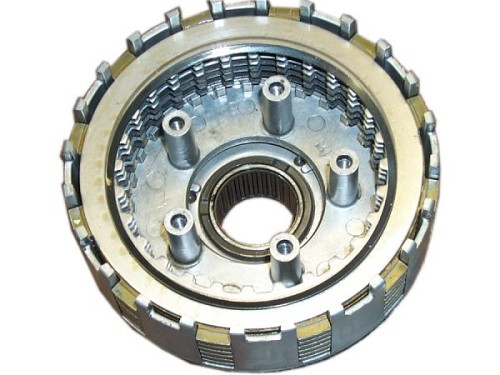
Here are the five threaded connectors used to secure the cover; however, they do not fasten it directly, but instead apply pressure to the vane assembly via springs. And now the Golf 2's clutch comes into play.
Specifically, when the clutch is engaged, a rod is used to lift the cover against the force of the springs by passing through the entire transmission shaft, releasing the clutch pack, though often with barely
more than a millimeter of total play.
kfz-tech.de/YGt14
kfz-tech.de/YGt13
|