Semi-automatic Semi-automatic
What exactly is a semi-automatic? Can something be only semi-automatic? Of course not exactly. Perhaps it would have been better to call these systems partially automatic. It is simply the combination
of automated and manual processes. That the former part does not necessarily play the main role is already evident from the first example, which may surprise you a little.
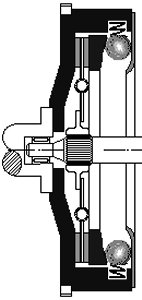
Who would have thought that the Citroën 2CV existed in a semi-automatic version? This refers to a centrifugal clutch, which was sometimes installed in early models of the 2CV. That
probably had to be included in the user manual just so that someone would actually use this feature. You didn't even notice them during normal driving.
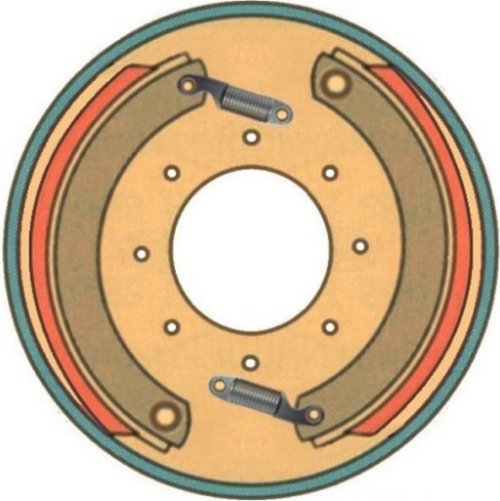
| Low RPM - Clutch disengaged |
And this is how it worked: You dared to simply release the clutch while the car was in neutral with first gear engaged. The foot brake was engaged on uphill and downhill sections anyway. And so
nothing happened. The car wouldn't start moving until a certain amount of gas was applied, which not only made it easier to start on a hill. The feature was also useful in traffic jams, since you didn't have to
operate the clutch yourself at all.
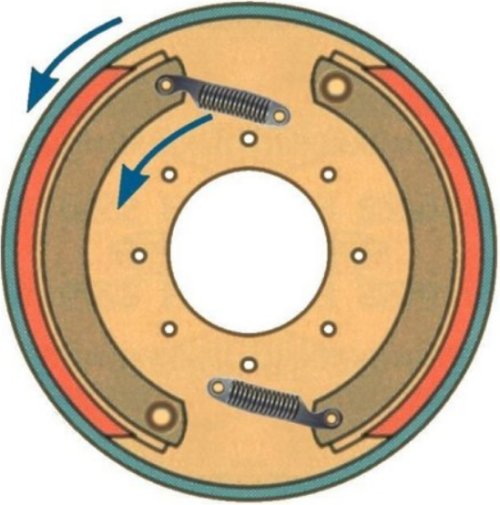
| Higher RPM - Clutch engaged |
As the name suggests, the engagement of the dry clutch, in this case is achieved by centrifugal weights accelerating toward the outside. The image above is only a schematic diagram. It was just a
clutch where the engine and transmission were disengaged both by the standard foot pedal and by a drop in RPM. At that moment, of course, the engine's braking effect was also lost.
| Saxomat combines a centrifugal clutch with an electro-pneumatically actuated clutch. |
Let’s take a look at the Saxomat (F&S), an advanced version of the centrifugal clutch available for many different vehicles. However, we’ll take a closer look at this using a prominent example that will be introduced later: the
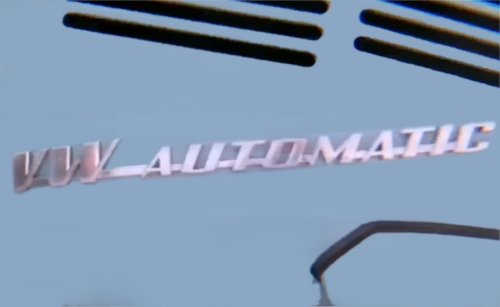
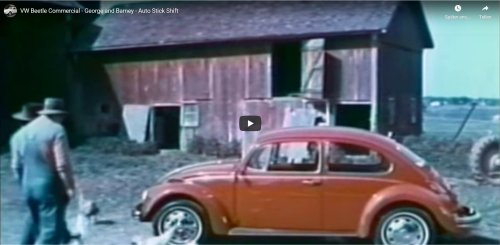
semi-automatic transmission in the VW Beetle. The manufacturer naturally called it the “VW Automatic,” and the first thing you notice when looking at the owner’s manual is the footwell, where the
clutch pedal has been completely eliminated.
And, of course, there's a woman behind the wheel. It seems this user-friendly feature is intended to attract a new customer clientele. It's funny what was still possible back in 1968. The instructions
actually include texts with word gaps that require you to pick up a pen. The solution will appear on the next page. Can you imagine something like that for today's user manuals?
Nein, diese Art der Abfrage betrifft nicht nur die Besonderheiten der Automatic, das ganze Auto wird auf diese Art durchgehechelt. Und dann endlich der frühere Gangknüppel, jetzt Wählhebel geheißen. Er hat
seine dritte Gasse für den Rückwärtsgang verloren. Der liegt jetzt, mit einer Sperre versehen, wo früher der erste Gang war. Im Grunde sind von den vier Gängen nur drei geblieben, hier allerdings mit L für Last,
1 und 2 bezeichnet.
The apparent intention is to get people to start moving in what used to be third gear. It feels that way, too. This is made possible by installing a torque converter, which essentially replaces first gear
and allows the vehicle to start off in third gear without the excessive wear that a dry clutch would cause. Only in special cases, such as when pulling away on a hill, should you use the second gear.
With the third gear, of course, comfort is a major factor, since the manufacturer clearly intends for drivers no longer to shift gears in the city. Only when you shift out of it is it advisable to shift back into
the previous fourth gear. By the way, unlike in the past, this gearshift lever, which has been repurposed as a selector lever, is already positioned in the right-hand shift gate by spring action when in neutral. Turning left is
only for reversing.
And how works the switch from L1 to L2? Even with a torque converter, the manual transmission, which would still operate conventionally, would not tolerate shifting gears without using the clutch. That's why there's an
additional shift clutch. By the way, it's significantly smaller than the one for the manual transmission. This shows that starting is the primary function of such a clutch and causes the most wear; shifting is essentially just a
secondary function.
And how is the shift clutch operated? It also comes with a servo motor. In a metal housing divided by a diaphragm, a piston rod is attached to one side of the diaphragm. If this side is subjected to negative pressure, the
force generated, depending on the size of the diaphragm, is sufficient to disengage a clutch.
The fun part is the action. In fact, all you need to do is move the selector lever slightly when you touch it, and a touch switch between the two parts of the lever will activate, opening a valve for the vacuum line coming from the
internal combustion engine. However, from a certain height, you had to bend your knees in the Beetle, which then promptly got too close to the lever and the engine screamed like a startled child while driving.
The era in which this design was developed is characteristic, as it takes into account neither favorable exhaust emissions nor fuel economy. This isn't exactly one of the VW Beetle's strong points to be honest, and it's
actually made worse by the torque converter, for example. Neither starting off in a higher gear than necessary nor staying in third gear while driving through town saves fuel.
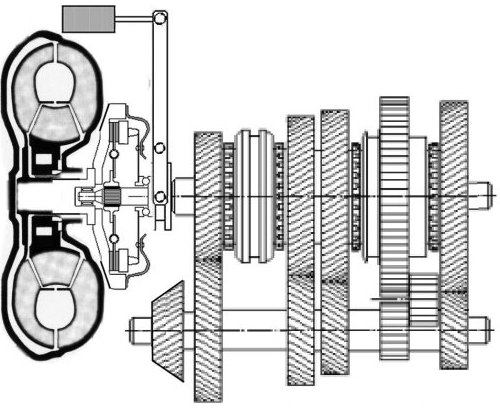
| Installation is possible in all drive types provided there is sufficient space. |
The picture above shows Porsche's semi-automatic transmission, which is called "Sportomatic" there. Since the Porsche 911 of that era had five gears, four remain here. As is typical in rear-engine vehicles, torque is
transmitted from the torque converter or manual clutch through the driveshaft to the transaxle at the front and only reaches the driveshaft via the transaxle’s output shaft.
Our exploration of semi-automatic transmissions in motorcycles brings us back to the centrifugal clutch. It is precisely their low torque that makes them more suitable for this purpose. On a moped, this happens, for
example, with the kickstarter and when starting off. More powerful motorcycles also use it for automatic shifting.
Still remains the replacement of the clutch pedal using hydraulics. The procedure for operating a valve that disengages the clutch using hydraulic pressure is the same as described above. The only thing missing is the
torque converter. Basically, the entire powertrain remains completely intact. The hydraulic system, which is generally more responsive, is also capable of engaging the clutch when accelerating to get the vehicle moving.
| The system was available as the "Hycomat" in the Trabant P 601. |
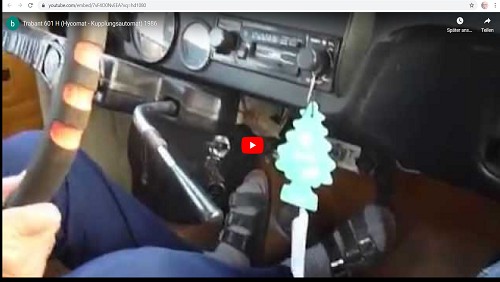
kfz-tech.de/YGt15
kfz-tech.de/YGt16
kfz-tech.de/YGt17
kfz-tech.de/YGt18
|