Basics 2 Basics 2
kfz-tech.de/PGt26
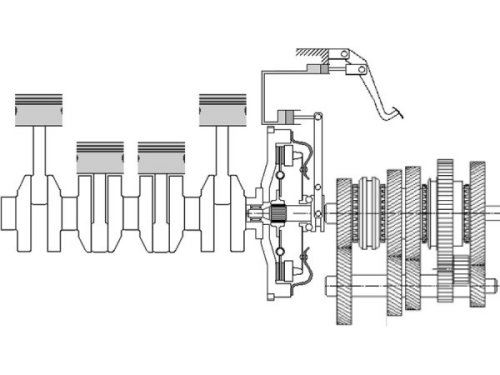
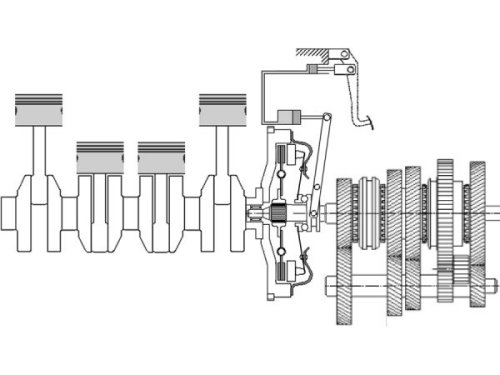
Let's take a look at the functions of the transmission in order. The engine and clutch must not be overlooked in this context. A classic four-speed transmission is best suited for this purpose, of
which we only want to consider gears 3 and 4 anyway. The only slightly more modern component is the hydraulic clutch actuation.
So let's proceed in small steps and consider as many operating variants as possible. Everything is still quiet; neither the engine nor the clutch, transmission, or its output shaft are rotating.
Although there is often no alternative today, we will start the engine first without and then with the clutch engaged.
What rotates in the first variant when the engine starts? Sure, itself and the clutch. And since it is not engaged, parts of the transmission are also forced to rotate. Since this is a coaxial
gearbox for a front engine with rear-wheel drive, the first gear at the top left of the input shaft drives the countershaft via the one below it.
So far so good, you might say, but what rotates on the main shaft? It is important to bear in mind that this is not connected to the input shaft. It starts somewhere on the left under the upper left
gear and ends on the right outside the gearbox. It should be noted that it remains stationary in the aforementioned operating state. No torque is transmitted to the rear axle.
But does that also apply to the gears arranged on it? Of course not, because each one is driven individually by the rotating countershaft, each at a different speed. One could say that the
rotational speeds of the wheels on the main shaft decrease towards the right, if we disregard the straight-toothed reverse gear.
It's interesting to think about everything the starter motor has to drive in winter, for example, in a manual transmission with stiff oil. Is that why you have to press the clutch in many cars these
days? Probably not. This likely refers to cases where a gear is accidentally left engaged when starting, causing accidents due to unwanted movement of the vehicle.
kfz-tech.de/PGt27
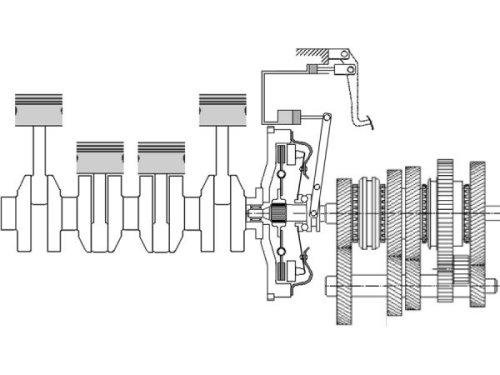
Now the clutch is depressed during the starting process. So it no longer turns as a whole. Only the flywheel, the clutch cover, the diaphragm spring, and part of the release bearing are still
affected. The rest, including all transmission parts, is at a standstill. Cold oil therefore no longer puts strain on the starter motor or its power consumption.
kfz-tech.de/PGt28
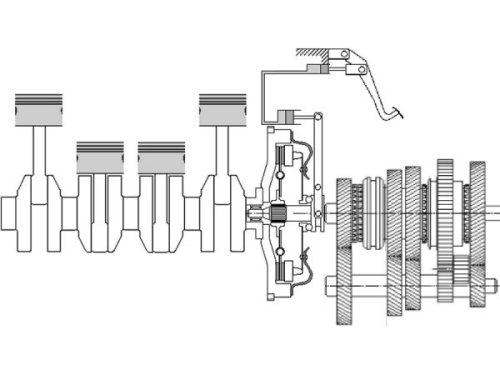
So, now we shifted into third gear instead of first, carefully released the clutch, and drove off. Here, all the gears in the transmission are rotating again except for the reverse gear, but the
torque is transmitted in the left gear pair to the countershaft and directly in the next gear pair to the right of it back to the main shaft.
kfz-tech.de/PGt29
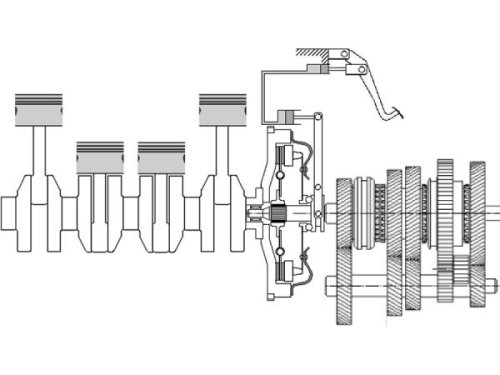
To get to our actual topic, namely downshifting, we had to accelerate and also shift into fourth gear. Once again, almost all of the gears are driven in some way, but none of them are involved
in transmitting torque. That and the engine speed come out unchanged on the right, just as they came in on the left.
kfz-tech.de/PGt30
We were in fourth gear and want to shift down to third. What we have already managed to do is to take out the fourth gear. What exactly is stopping us from simply shifting the gear stick from
neutral to third gear now?
To do this, you need to look at the rotational speeds. The engine, together with the flywheel and clutch cover, has too low a speed for third gear because it was just connected to the axle drive
via fourth (direct) gear. In principle, this is also the speed of the clutch disc and the gears in the transmission. Just the main shaft under the top four right gears turns too fast for third gear.
The shift sleeve follows this speed, meaning it is also too fast to engage with the pre-engaging teeth of the third gear. In the past, in this situation, you would have
released the clutch again and used double-declutching to accelerate the third gear slightly. When shifting up, there was a slight pause between two clutch engagements.
| The tachometer was probably invented for the precise measurement of
the gas boost. |
The main problem was downshifting. Woe betide if the gas burst was not adequate. Whether too weak or too strong, there was a crash when, after pressing the clutch again, you pushed the
gear stick towards third gear. If, after a possible knocking sound, you did not dare to go through with it or if it was impossible to engage the gear, the process had to be repeated with double-
declutching.
For good reason, especially with trucks, drivers used to shift down before reaching an incline. Then, at least the speed remained reasonably consistent after more than one attempt. In the
mountains, there was a risk of coming to a standstill, requiring a restart and possibly causing trouble for the vehicles behind. So anyone who lived at the foot of a steep slope had to get used,
for better or worse, to the background noise of multiple attempts to shift down.
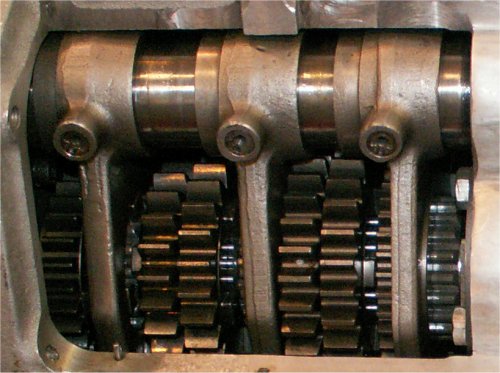
The gearbox shown so far is suitable for downshifting with double-declutching, as only one pre-meshing gear is visible on the shiftable gear wheels. They are also referred to as 'shift claws',
which is where this type of transmission gets its name. It represents an improvement over gears with straight-toothed sliding wheels. Just imagine the length of the shifting paths
when entire wheels have to be correctly nested inside each other (picture below).
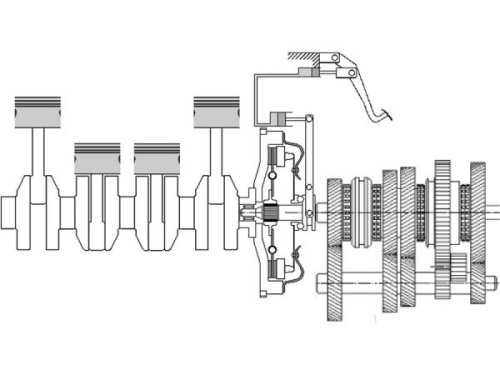
Finally, a solution to the synchronization problems. The friction surfaces on the synchronizer rings, which are shown here in addition and are actually a little more compact in reality, ensure
that the speeds are automatically adjusted. Of course, this also requires that the engine remains disengaged during the adjustment period by means of a properly operated clutch.
kfz-tech.de/PGt31
The less mass that needs to be synchronized with the constant speed of the output shaft, the better. In the clutch, it is only the comparatively light clutch disc. However, if the transmission is
installed further away from the engine, as is the case with a transaxle design, the synchronizer rings have a slightly harder time. Nowadays, double-declutching has become completely
unnecessary anyway, as it tends to increase wear and tear because it is almost impossible to master it 100%.
| A modern manual transmission can be checked by, among other
things, shifting down a gear more forcefully. |
|