History - Wunibald Kamm 1
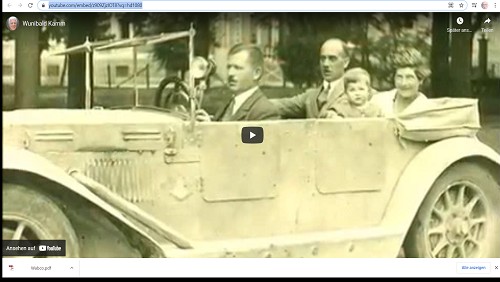
kfz-tech.de/YGe39
If you've been interested in automotive technology for a longer time, you've probably heard of him. No, not directly with his unusual first name, but you may be familiar with Kamm's friction circle, or the K-tail, a technical term
from aerodynamics, one of the most important areas he has dealt with, but by no means that only.
We are talking about Wunibald Kamm. He was born in Basel in 1893, so he was still a Swiss citizen until the First World War. He only had three sisters left after his older brother died early. In 1900 the family moved to
Stuttgart, so that he spent his school days in Germany, by the way, he made friends with his classmate and youngest son Gottlieb Daimler.
Kamm was both a good student and very talented in sports. Perhaps that saved his life when he volunteered in 1914 after graduating from high school and started studying mechanical engineering and was employed as a
captive balloon observer. That sounds funnier than it is. At that time it was still believed in military circles that aviation could be used to explore enemy lines, e.g. with airships.
But there were more planes in the sky and it was not difficult to hit such large balloons. So that the observer crouching in a gondola underneath had only a quick escape down the rope, at 300 to 500 meters a race against a
hydrogen-filled balloon that burned down at the top. And if it wasn't the planes, the crosswinds could be pretty dangerous. Well, he survived it, and has also received several awards.
His friend Gottlieb Daimler wasn't that lucky. He was killed at the Battle of Verdun. Both of them had dedicated themselves to flying and fortunately there were numerous events even then by famous personalities in this area
on the Cannstätter Wasen, where also the annual, bi-weekly folk festival took place. In general, the Stuttgart - Karlsruhe region was one at the time technologically prosperous landscape.
At the beginning of his studies at the Technical University in Stuttgart there was a new chair for aviation, which later included automotive engineering. One did not yet suspect that one day Kamm would inherit his favorite
professor Baumann. You can hardly imagine the bustling activity of Kamm, after resuming his studies, also still working as a project engineer.
Nevertheless, he graduated with honors. After that, he had almost inevitably made constructive changes to the captive balloon and moreover earned his doctorate with distinction. And since the cords of tethered balloons
were hauled in with an internal combustion engine by the Daimler-Motoren-Gesellschaft, for example, it was not only in this context that contact was made with chief designer Paul Daimler, the older brother of Gottlieb jr.
Kamm started as an apprentice in the Daimler design office in 1922.
And so that we could once again gather as many well-known inventors of automotive technology as possible in one story, Ferdinand Porsche moved to Daimler in Stuttgart in 1923. Kamm also helped to design the two-liter
eight-cylinder engines with a compressor, which Porsche took over from Daimler as prototypes. The first racing successes followed, as was usual at Porsche. Not really Kamm's thing, and although Porsche made him
tempting offers, he left DMG in 1924.
Kamm had come to the economy of a small car through aerodynamics, and had already carried out such a project with an engineer friend. At the Schwäbischen Hüttenwerken he got the chance to do
something like that in a team. In just under two years, a still angular car with a water-cooled two-cylinder boxer, mid-engine and front-wheel drive was built. The compression of the wheels was absorbed by sleeves with
integrated coil springs.
In addition to the difficulties of durability only with permanent filling of lubricated joints in the front half-shafts, there was also the raising of the mid-engine in order to generate more foot space for the front passengers. Front
wheels with additional brakes were not the norm back then. The use of light metal made the vehicle lightweight, but also expensive to manufacture and made the SHW superiors shy away from realizing it.
Even Messrs Popp and Friz from BMW are said to have been interested in the car. After all, the year was 1926 and only two years later they started manufacturing four-wheelers under license. In the same year, Kamm
switched to the Deutschen Versuchsanstalt für Luftfahrt in Berlin as head of the aircraft engine department. In the Nazi empire everything that served armaments was promoted and aviation was given
priority over the navy. Kamm stayed until 1930.
|