|
 General Motors 1 General Motors 1
kfz-tech.de/PGe66
If Henry Ford dominated 50 percent (or even more) of the world with his Model T, so did General Motors in later times, albeit only in the United States and Canada and with an enormous fleet of Chevrolet, Pontiac,
Oldsmobile, Buick, Cadillac and GMC. GM also had a large share outside of Germany, in addition to Vauxhall in Great Britain and Opel in Germany.
Yes, it is a long time ago, the extremely successful post-war period of GM, additionally promoted by a weakening competitor Ford, who was struggling to succeed it. The founding of the group in 1908 was probably primarily
due to William Durant. He is the second automotive visionary to be mentioned in connection with Henry Ford. The automotive industry was an absolute niche market at the time.
kfz-tech.de/PGe67
Yes, construction of the Model T began in 1908, but assembly line production was still more than five years away. Unlike Ford, Durant bought Buick and Olds (later Oldsmobile) the year it was founded, and Cadillac and
Oakland (later Pontiac) the next year. By 1910, about 20 companies were added, all of which continued to work independently.
Not all of them were car companies and only the first four really remained part of the group. Together with Ford, Durant had the aim of producing as much as possible in-house, which is why a considerable number of
accessories companies were grouped around the four parent companies over the years. The competition in 1910 was incredibly numerous, but apart from the Ford group, which was only slowly expanding, it was still of little
importance.
kfz-tech.de/PGe68
Brands such as Packard, Studebaker, Hudson, Overland, Corbin, Durocar, Fuller, Austin, American Napier, Schacht and Thomas were reasonably well known that year. Since only Buick from the GM group was actually
profitable, GM was already falling behind at this time. William Durant had to give up the presidency. The expansion in the car market between 1910 and 1915 suited GM, but at the same time the now increasingly cheaper
Ford outstripped it.
Incidentally, just for comparison: In 1911, around 15,000 cars were sold in Germany and 210,000 cars in the USA. As early as 1916, this ratio was 7,500 to 2.1 million, also because the First World War was raging in Europe.
In 1918 Durant was back at the helm of General Motors. He had brought Chevrolet into the group, a company he co-founded in the meantime.
kfz-tech.de/PGe69
In 1920, the demand for automobiles began to saturate significantly, which also affected GM. Ford partially escaped it by once again lowering the price to that of a motorcycle with a sidecar. GM had nothing to counter this. The
cheapest Chevrolet cost $ 800. It turned out that there was no structure and liabilities in the thrown together group.
Durant had to vacate his post again. In addition, an unfortunate development of air-cooled engines with copper cylinders, initiated by Charles Kettering, began, which became never really ready for series production, but threw
almost the entire group back in development. After returning to water cooling, Kettering received its own research department for its future inventions (> 300 patents), from which e.g. lead tetraethyl to increase the octane
number emerged.
From 1923 Alfred P. Sloan became President. He joined General Motors in 1918 with his rolling and plain bearing company. With it began a long phase of consolidation, almost more difficult than the introduction of assembly
line production at Ford in 1913, because there was only one car and with Lincoln only one sister company. Also, at GM, there were many more people involved in a decision. The departures of Charles W. Nash in 1916 and
Walter P. Chrysler in 1917, both of whom founded rival companies, must also be mentioned.
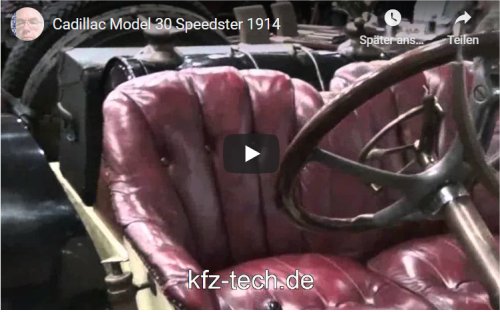
kfz-tech.de/YGe19
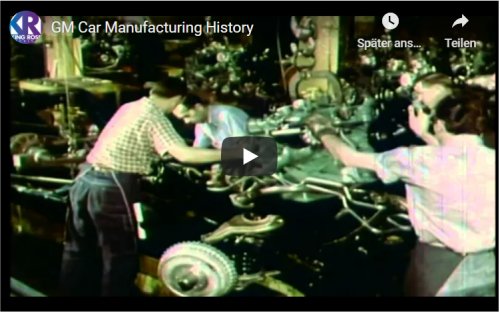
kfz-tech.de/YGe20
|
|