|
| 
|
 EA 288 EVO EA 288 EVO
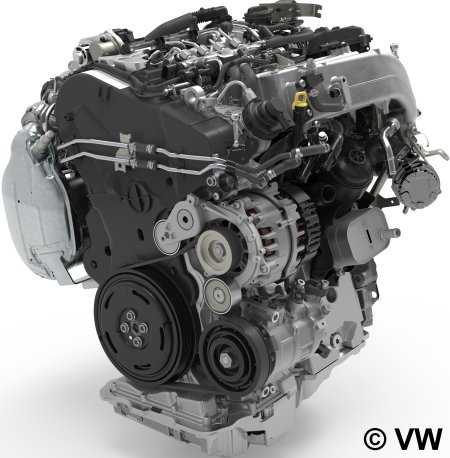
At the 2018 Vienna Motor Symposium, VW is not only proud of the thoroughly revamped new EA 288, but also of the expanded possibilities offered by a so-called 'virtual construction stage'.
This means nothing less than that everything necessary for decision-making was provided exclusively in digital form. In other words, the motor does not yet exist, but it is still possible to estimate its service life
and many other factors, such as its efficiency and noise behavior. The beautiful part of the new digital world.
Some time has passed since the disaster, and the immediate damage has been cleared away, apparently as well as possible so far. And now they are looking for a way forward, in this case for the
diesel engine in VW vehicles. No, it cannot be completely abandoned, because heavy vehicles all depend on it, including many of the ubiquitous SUVs.
| Long-stroke engine (81,0 mm * 95,5 mm) still typical for a diesel engine here. |
However, this kind of new beginning is not without drastic consequences. Want an example? There will no longer be any diesel engines with a displacement of less than two liters. The stroke and bore remain
the same, but, for example, a different die casting process is used for the new aluminum cylinder crankcase. It further increases strength, particularly in the area where the crankshaft and cylinders are
mounted. An incredible 20 kg are saved compared to the gray cast iron part, which once weighed almost 47 kg. Coolant and oil channels are integrated.
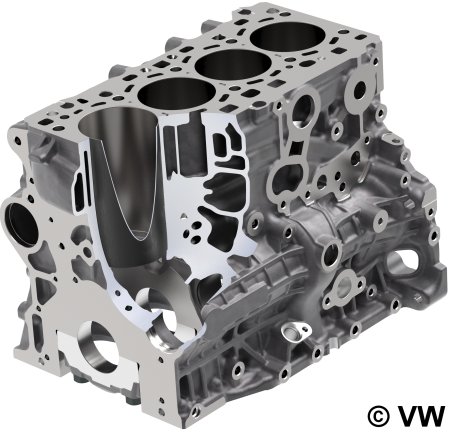
| Cylinder crankcase with thin-walled gray cast iron liners |
The crankshaft is also becoming more lightweight. A real flywheel has not existed for a long time. The two balance shafts are located at the most efficient points in the engine, connected at the
intake side at the bottom via one gear, and at the exhaust side at the top via two gears. Their drive wheels are straight-toothed and divided into two parts. This allows for a certain spring-loaded
offset between the two gears, thereby preventing noises, as a steel gear drive in an aluminum housing requires a certain amount of play depending on the temperature.
| The main components remain the same for both performance variants; only the add-on
parts vary. |
If two performance variants of the same engine have different outputs, it is easy to assume that they are also identical internally. Despite only 20 kW and 20 Nm, this engine features aluminum pistons instead
of steel ones. What can calculations reveal? Despite the bore and stroke being identical, the connecting rod is shorter because the aluminum piston is considerably longer. In terms of weight, therefore, the two
are not as dissimilar as the choice of material might suggest. In addition, the more powerful engine has been given more main and connecting rod bearing width. Of course, it must be clear
that for it, the current torque and power levels can also be the starting point for further increases.
It's incredible what modern measurement technology can conjure up on the monitor in terms of a three-dimensional flow field. It helps in the reversion of the two camshafts to the classic distinction between
intake and exhaust sides. The twisted star made up of four valves and an injector is a thing of the past. Turbulence is apparently achieved even more effectively through channel routing and additional designs on
the cylinder head. At the same time, much greater attention is now being paid to ensuring good airflow. Incidentally, the vacuum pump is now located on the camshaft drive and, given the presence of electric
brake boosters, will probably only remain there for a limited time.
Initially admired, the oil pump drive via toothed belts has proven itself. Based on the characteristic map and with an extra solenoid valve for oil spray cooling, the normal supply could be reduced again in terms
of pressure. The oil is now at 0W-20. Although this is actually mandatory for every engine overhaul, a 25 percent reduction in friction power at the lower power level is already remarkable. Below, you can finally
see a component that has been around at VW for quite some time now: the intercooler integrated into the intake manifold.
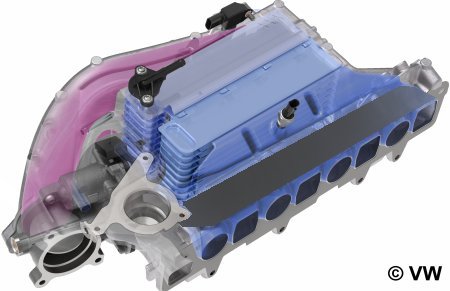
In addition, there is a dark gray channel for high-temperature coolant from the cylinder head to the exhaust gas recirculation valve on the left. Accordingly, the intercooler naturally requires
coolant from the low-temperature circuit. High- and low-pressure exhaust gas recirculation are now arranged differently and can even be used for cold starts and warm-up phases. When it comes to charging,
there is talk of greater throughput and a ‘new VTG generation’ for the lower power range. Obviously, the efficiency here is so good that smaller displacement versions are hardly worthwhile.
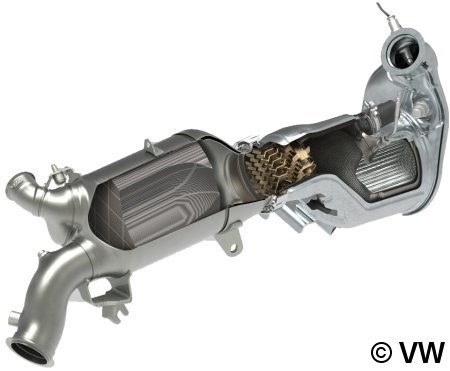
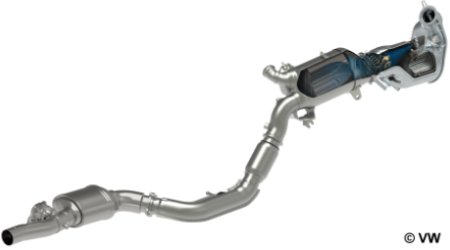
Of course, no one is willing to expose themselves when it comes to exhaust gas detoxification anymore. Above, you can see the enlarged oxidation catalyst on the far right and, behind it, an equally
voluminous particulate filter, which also provides selective catalytic reduction thanks to a special coating. In between is the SCR mixer and the corresponding dosing module. Below is the complete
exhaust pipe route once again.
|
|