Summary 2
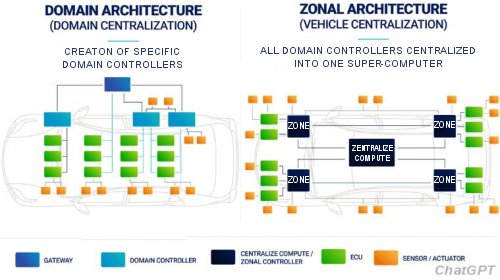
Traditionally, the computers (control units) in vehicles, up until 2020 respectively 2025, are organized in a domain architecture. This means they are assigned to specific areas of the
vehicle based on their functions. Over time, these are organized into larger groups, so that each one no longer deals exclusively with, for example, the brakes or the ABS.
In advanced domain architecture, this has long since been integrated into the chassis control computer, or, in the case of engine software, into the powertrain functional domain. Each
domain had its own controller. So this was already a first step toward reducing the number of control units.
But, for example, the performance expense to the sensors was still high because the operational ranges of the individual controllers overlapped. It's easy to see that the zone calculator
helps a bit more here. It's also important to note that today's cars have fewer zones than they used to have domains. So this is another step toward density.
Nevertheless, in a zone-based architecture, a central high-performance computer remains despite the reduced number of control units. The functions must be coordinated and, for example,
assigned to the local deployment of an OTA update. This package also includes software that is hardware-independent.
In fact, middleware plays an important role precisely in this context. Changes can be made without explicitly knowing the hardware. Conversely, a mistake can more easily affect larger areas,
and anyone who has gained unauthorized access here has significantly more opportunities.
How have suppliers reacted to the introduction of such systems, and what does their collaboration with OEMs look like now? For example, they offer complete central computers: Bosch's
Central Vehicle Computers, Continental's central E/E platform, and ZF's ProAI, which is one of the most powerful vehicle computers available.
At this point, at the latest, we learn a new term that contrasts with the one we’ve been using for ages - the Central Processing Unit - namely, the Graphics
Processing Unit. Unlike the former, the latter is designed for massive parallel processing, thousands of operations simultaneously.
Here, we'll look at just one example of a GPU's range of tasks. It would involve analyzing images and comparing them, perhaps with patterns, which would bring us to autonomous driving,
or at least the path toward it that nearly all new vehicles are taking. This, too, must find a place in a modern software architecture.
And while we're on the subject of algorithm placement, they must be designed with at least two systems, for example, in an emergency braking system, and even three in a drive-by-wire system.
From all this, you can see that the days of CAN buses and other buses coexisting peacefully, without the software being exposed, are over.
Perhaps the definition of a software-based car isn't so much about infotainment as it is about the internal structure of the other systems in modern vehicles.systems that are far more important for
driving and safety. That's where integration is now becoming particularly important. Perhaps most of the changes here won't even be noticeable to the driver.
Cooperation between OEMs and suppliers is literally getting tight. Why? A very simple example would be if one supplier provided the control unit for the electric parking brake and another supplied
the suspension adjustment system for trailer operation, both integrated into the rear-zone control module.
ChatGPT notes that OEMs are taking on significantly more control over software, to the point of assuming many of the tasks previously handled by suppliers. Conversely, as manufacturers of complete
modules, they can significantly expand their scope of operations. Possible interim solutions and the related legal issues perhaps in a separate chapter.
|