Risks of the software 2 Risks of the software 2
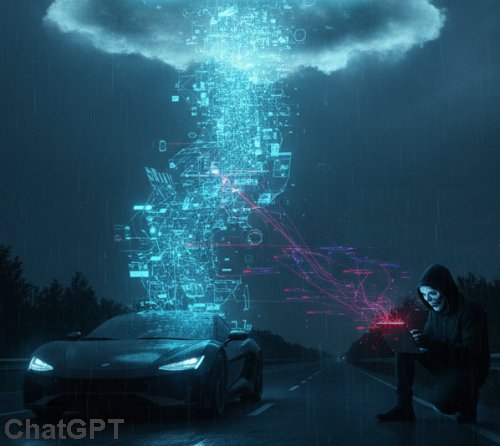
The topic is not easy to explain. One could simplify matters by stating that a vehicle must simply be secure against external attacks. But that's even less possible where information has to be funneled through the public
sphere.
But let's start particularly early and deliberately take a safety-related area, namely that of brakes. For ages, we have been accustomed to pressing a pedal that sends pressure from hydraulic fluid to the wheel brake via a
piston.
There, the pressure is converted into motion, which presses the elements with a sufficiently high friction factor onto rotating parts. As long as no one from outside damages the cable, the system is
reasonably secure.
Furthermore, such damage would be noticed during the first braking maneuver and the vehicle would not continue driving. A defect would even be manageable because all cars now have two circuits of hydraulic fluid.
And the reduction in function is even noticeable here, because at least the first pedal travel has become longer. This should be especially emphasized because, in the course of this and the following chapters, we will also
learn about the failure of functions that are not immediately noticeable.
Since it was determined that wheel lockup during braking must be avoided at all costs, electronics have come into play and their safety has become an important issue for the first time. because it forcibly reduces braking
in critical situations.
From that point on, one could already speak of a software-based brake, because it could completely put it out of action in the event of a malfunction. This is where redundancy comes into play for the first time, i.e., the
duplication of systems as protection against failure. From that point on, one could already speak of a software-based brake, because it could completely put it out of action in the event of a malfunction.
Incidentally, this must be tripled in the case of a system such as 'steer-by-wire', because if a control unit fails in a curve, two additional systems are required to register the failure and guide the car safely through the curve.
Now we already have two safety-related systems, brakes and steering. Modern assistance systems use both to actively maintain the lane, even when cornering. Or perhaps to enable the car to park itself.
That's a big step, because nowadays cars generally can't do that on their own. While a lot of bugs would already be possible up to this point, the above-mentioned step via the public space comes into play now.
Who actually came up with the term ‘cloud’? What is happening now has nothing to do with the supernatural or the clouds. Data is simply sent to another, much more powerful computer, which is, for example, accessible
to the manufacturer.
Unnoticed by the driver, the vehicle uses additional data, e.g., on topography or current traffic conditions, in order to perhaps achieve a result more quickly. Thus, the relatively simple problem of braking and steering has
become a widely used technology.
|