New Players New Players
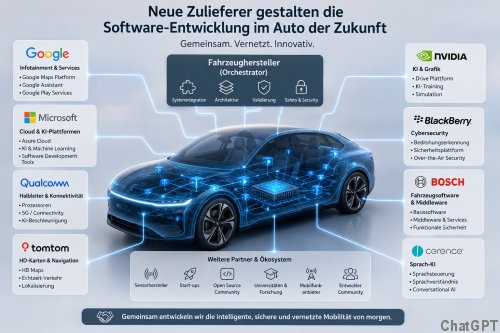
New suppliers are shaping software development in the car of the future.
The original idea was to bring all the wonderful things that people could eventually do and experience on their home computers into the car. And it was clear from the outset that this would pose special safety challenges
while driving.
From the very beginning, voice input was seen as a good solution. But unfortunately, it wasn't quite ready yet. It understood only key words, and even with those, a certain tone of voice sometimes had to be used. The
widespread use of AI in the automotive industry has now paid off.
Today, you can activate and deactivate almost any function in a car using voice commands, regardless of whether the voice belongs to a man or a woman. It is not possible to determine what task the system is given that
would require the cloud to be activated, or whether that is always the case.
For example, our car doesn't even have a navigation system. However, it is possible to install something like that on our center display using Android Auto. In that case, voice input is even possible. But there is one thing the
system cannot do: execute standard commands related to the vehicle's operation.
That is not where future digitalization is headed. But this requires the cooperation of at least the OEMs, and perhaps also any remaining suppliers. We don't need to dwell on internal combustion engines at all,
but simply need to enable the driver of an electric car to check, for example, the battery's status.
This is now the page dedicated solely to vehicles. However, if, as seems quite reasonable, one wants to establish a connection between the battery's status and the navigation system, then entirely new
collaborations are needed. And not only that - in winter, for example, you might want to prepare the battery for an upcoming visit to a charging station.
That sounds like a very well-organized system, in which the two components, battery management and navigation, can be consulted and then turned off again. But in practice, that's not the case. The systems may even be
used in a haphazard mix, and other factors-such as fuel consumption data-are also taken into account.
While suppliers are no longer needed in vehicle development, due in part to electromobility, new ones are entering the field; in the case of Microsoft and Google, these are players of considerable size and market power.
This results in a very different mix of developers than in the past.
It also seems that these groups are much harder to split up. It's not possible to work on different parts of the car, such as the suspension and drivetrain, separately for a long time and then meet up from time to time. It
seems that we need to coordinate this within a few days.
Companies operating in the automotive software sector can be divided into those with close ties to automotive engineering and the major tech conglomerates mentioned earlier. They have the clouds and,
at best, set up clouds for the OEMs or work with them. Of course, the question of where the data remains.
If you consider that PC programs made by Microsoft or Google also have voice input, it suddenly becomes clear just how close the collaboration must be to bring both - or even more - voice input systems into alignment.
But it must also be clear that, regardless of which companies and developers worked on the project, the car remains a fortress, meaning there is no mixing of data, even though users
bring their entire work or entertainment environment with them. Figuring out how to keep all of this straight is quite a challenge . . .
|