The Future of AI 1

You've already seen this image in the "AI 4" chapter. Why are we showing it again here? Because we want to highlight another feature of ChatGPT. We're actually having some trouble with
the Spanish translation, which Juan in Buenos Aires is handling for us.
But we don't want to burden them with not only translating all the text in the image but also integrating it into the image. He s already cheap enough. So what should we do? Leave a lot of things out,
and let ChatGPT handle that for us.
The task was to keep only the cloud with '€166.90' and the text on the sheet, and to leave out everything else, especially the small slate board on the right. Just before the prompt, one more thing:
Could you please translate the rest directly into Spanish?
Mind you, these aren't texts you can just pull out of the image on a whim. And in fact, ChatGPT did take a little longer. But in the end, the image below is the result. Please note that the AI has retained
two additional texts and translated them into Spanish.

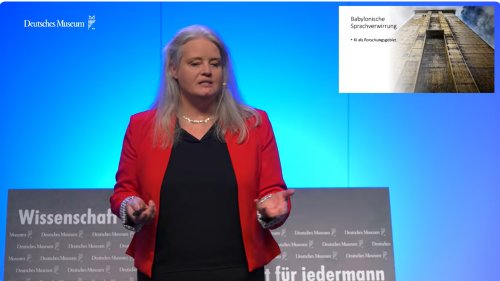
Which brings us to the actual topic of this chapter. Who is actually right when it comes to assessing AI's capabilities? Take a look at the analysis by Professor Zweig below.
With the utmost confidence, she is currently claiming that AI is, in fact, incapable of comparing, analyzing, evaluating, and summarizing. Has she accurately assessed the capabilities of AI, or are we in Germany once again
lagging behind in this area?
Even in our modest example, the AI has at least managed to perform a comparison. But doesn't it go beyond that, that it retained more of the text than we had asked of it, which, in hindsight, we have to admit was a good
thing?
With our suggestion, the whole thing might have been too difficult for Spanish-speaking readers to decipher. Are the modest capabilities that Professor Zweig attributes to AI
really all there is, and nothing more?
Suppose we’ve just been programming in C++ together with the AI, and then a little later we present our main program in outdated Delphi 5, and the AI still advises us to stick with this old framework and to
adapt it piece by piece to our evolving requirements.
Isn't that much more than what the AI in the video below is credited with being capable of? When we ask to replace a woman in a picture with the current Minister of Economic Affairs, it's just this same old, overused
language model? So there's no immediate danger, is AI basically harmless?
Definition of 'artificial intelligence: 'All computer processes that would require intelligence if performed by humans'. Is this useful? Probably not, because 'intelligence' is hard to define as 'intelligence'.
| A term should never appear within its own definition. |
She makes a second attempt: 'We start from what we assume the computer can't do'. The moment the computer can actually do it, we call it 'AI'. It really doesn’t get any more helpless than that.
kfz-tech.de/YSD33
| How many people are there, really, who actually know anything about current AI? |
|