Artificial Intelligence 1 Artificial Intelligence 1
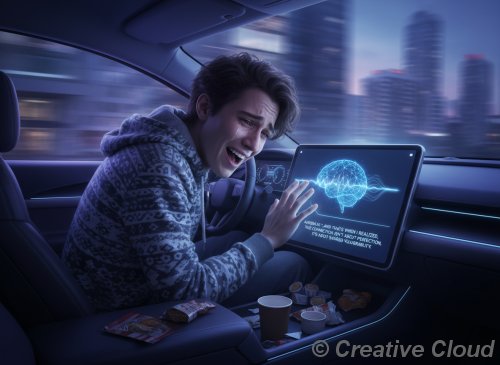
We currently use AI frequently to describe images for some of our chapters as accurately as possible, and we have to say that the more we succeed in doing so, the more satisfied we are. You can
track this, in my opinion, because we now label all of them with their copyright without exception.
AI is repeatedly mentioned as an auxiliary tool in the increasing integration of software into cars, which is why we have decided to address it in this book. No, we don't have such a great fear that
the AI software will one day overwhelm us with incredible intelligence.
We consider the fact that there is usually a company behind it, which is forced to think about its stakeholders, among other things, to be much more dangerous. This is quite different from the address of Santa Claus up in
Lapland, to whom you send your wishes.
What we mean by this is that there are clear signs that the number of reasonably successful relationships between people is declining, becoming less stable, or not even coming about in the first place. What's still
missing is that someone might get into their car to become intimate with the respective AI in some way (image above).
We are used to something similar on social networks, and unfortunately the approach of "Hey, come to me, I'm your friend" is also being encouraged. There is a significant risk that young people will fall into this trap and
mistake the machine for the real thing.
What AI offers is cleverly prepared statistical material modulated to a treasury of human experience. This could have a certain appeal and make people forget that there is no real person behind it.
Well, you probably already know or have thought about that. But what is not taken into account enough is that companies use everything they spend money on in some way for their own purposes. In other words, there is
an interest that is often not even apparent to adults.
We are currently gaining experience with software programmers, who are almost exclusively men. These are not always good, even if they claim to want to gently introduce us to the processes of software engineering.
Very often, they only succeed partially or not at all. It's because of their language and behavior. We have noticed that despite good salaries, very few have a degree in information technology. Most of them come from the
fields of business administration or sales.
You actually notice your own language very quickly: many words with perhaps rather limited content. These are terms that are rather unfamiliar to ordinary mortals, but they are not explained and perhaps serve a little too
much to promote self-image.
If you think about it, you might realize that most software pirates are sought after for digital assistance in sales, have to be able to promote themselves, and paint big pictures on the wall. Proof of correctness comes much
later.
And you can't get rid of this impression with AI either. A very pleasant language with rather rare certainty, almost no insistence. If you point out a glaring error in the program, it apologizes politely and continues in a brief
dialogue.
But at the same time, it encourages you to take advantage of the enormous background. These are sales pitches; no one talks like that among friends. The danger here is that such a friend could come in handy in certain
situations in life.
|